17 December 2012

Letters to Kelly Clarkson

The overriding conceit of Julia Bloch’s first book Letters to Kelly Clarkson (Sidebrow Books, 2012) is a series of epistolary prose poems addressed to American Idol cum pop star Kelly Clarkson. And like other collections that follow a similar form (e.g. Spicer’s After Lorca or Wenderoth’s Letters to Wendy's), direct address to a cultural figure or entity infuses the book with a certain amount of levity. But the humor inherent in this imagined correspondence does not negate the more serious theoretical concerns of the book. In an interview on rob mclennan’s blog, Bloch states that Letters explores “representations of female celebrity, the female body as a spectacle, reality TV as a profit machine that we feel emotionally attached to, our relationship to pop culture, our desire for and fear of intimacy.” Take, for example the following letter:
Dear Kelly,

Clutched in femininity’s dystopic embrace as if it were a big clammy hand from the deep, I watch the bright box, forgetting to blink, I know I should be turning to the book and reading and writing but the images keep coming, trafficking my sense of the real and the room. The screen is sometimes described as an eye or a tube filled with celebrity jelly. I can’t see any of your pores; I know I shouldn’t but I want you to be a real girl, muscular, with a hair shade that doesn’t make a sound. (43)
“Clutched in femininty’s dystopic embrace,” the speaker foregoes her work-related tasks of “reading and writing,” even suspends normal body functions such as blinking, in order to “watch the bright box” of television. And the images the television provides distort her “sense of the real” by slathering them in a “celebrity jelly” that erases all trace of naturalness (e.g. “pores” etc.) from those who appear on the small screen. Yet even though her sense of reality has been distorted, the speaker still yearns for Clarkson “to be a real girl.”

The problem, of course, is evident: if we desire something “real,” but television alters our fundamental perception of the “real” through fabricated imagery, what is it that we desire? A previously false and fabricated image, or some long-lost image that predated mass media and consumerism? Trafficking between our new, fabricated realities and some lost authenticity, then, produces a compelling tension within Bloch’s book. On one hand, the speaker informs Clarkson of her need to “write to you in consideration of subjectivity” (24), but knows the difficulty of doing so when viewing the world through the “great eye of public” (5) and its “aesthetic of the shitty” (65).

The speaker of Letters to Kelly Clarkson, thankfully, does not sound overbearing or didactic because she imbricates herself with the public and its shitty aesthetic. In one instance, she confesses that: “I try to dignify myself on the pale couch, writing these notes down, but inside I abandon myself to the next huge dream…Girl you sure were swell up there, backlit and startling” (7). The speaker tries to maintain an objective distance by “writing these notes,” but inevitably abandons herself “to the next huge dream” produced by the image of Clarkson “up there” on a televised stage, “backlit and startling.” In another instance later in the book, Bloch writes: “On television, we can see each curve of your skull; you live in a land of light gels and leg doubles” (38). The use of the first-person plural revives the notion of the “great eye of public,” in that we all “see each curve” of Clarkson’s “skull” in unison; moreover, we see it in a world of artifice becoming reality: “a land of light gels and leg doubles.”

How, then, should we proceed in this world of mass-produced and contrived subjectivities? Toward the conclusion of the collection, Bloch writes:
I think I should like to be erased, like a certain word is from these letters. No: I think I’d like to hold a certain feeling like a cut thing, with the light shining all around your forehead and the last failed years toppled over at the entrance to 101 on Bayshore. (75)
The speaker’s first inclination is for complete removal from our cultural landscape, to be “erased” like a word from her letters. But such a response is self-annihilating and, ultimately, futile, in that it does not produce an affirmative reaction to a problematic trend within our contemporary times. No doubt understanding this fact, the speaker immediately negates her initial response (but does not “erase” it from her letter) and, instead, desires to “hold a certain feeling like a cut thing” in the “light shining all around” Clarkson’s head. Perhaps we can interpret this as some oblique reference to Adorno’s belief that: “The detached observer is as much entangled as the active participant,” and her recognition of that entanglement offers “the infinitesimal freedom that lies in knowledge as such.” Yes, the speaker is wholeheartedly part of the “failed years” and does view it through the great public eye; but, she is ever mindful of this knowledge, which provides her an “infinitesimal freedom.”

10 December 2012

cadences

j/j hastain is a performance artist, photographer, musician, and writer living in Boulder, CO, as  well as the author of several books and chapbooks of poetry. j/j's most recent collection cadences (Triton Books, 2012) explores the confluence of language and the body in order to “invent then arrange” the “infinite refractions” both through a series of longer poems and lyric essay that read as “strange, misty sequences.” hastain kindly took some time via email to answer some questions for me about the book.

In the afterward to cadences, you mention that the book works with "language in an attempt at making new constructions that refuse binary norms and enable multiplicity." Could you explain, perhaps in a bit more detail and pointing to particular instances, how specific language in cadences achieves this goal?

Thank you! I would say that as much as cadences attempts this goal of enabling multiplicity and refusing (torqueing, altering) binary norms, it “achieves” it. I would love to explain how the attempts/intents work/ed for me.

First off, the entire book is a large scale progression from what could be termed poetry to what could be termed prose. By poetry (called “divergent virago” in cadences (eg: “shared/we are/coming/to identify as a realm wherein/the vivid feels”)) I mean, pages whose obsessions include line breaks. By prose (called “cultivating cadences to invert the given creed” in cadences (eg: “on that brink or this one, compressed and drenched feathers are often mistaken for human blood”)) I mean pages whose obsessions include the flow of language, the elongation of lines into stretches in a continuity. There is a middle section of the book (called “in desperate pursuit of non-vaginal virginities or “now that we are here what other ways are there for us to cross”” in cadences (eg: “It helps to not be able to see the sky or the ground. Instead such concentrated elaborate mid. A marsupium unearthing. We/ eat phallic shapes/ in public”)) that blends both of the above stated obsessions. I see the mid-book as a location that expresses a healthy refute/alternate to the poetry/prose binary.

cadences was composed in the above stated regard intentionally, in order to provide and establish a path (parallel) to enable embodied examination of the binaries of masculine/feminine and male/female. It was important to me that the poetry/prose binary be turned into a poetry-third thing-prose place (the seeming poles brought together and connected by something of more duration than a hinge (as is often at the middle of a binary). I wanted to create the sense of a ‘third thing’ holding space, a boat (that thought it bares the historical weight of having two ends) that had enough (a blend) of both poetry and prose obsessions in it for it to offer realm, croft, a hearty, meaty middle (as opposed to it offering only a hinge and the poles on either side of that hinge).

Much of the content of cadences is artful undermining of the traditional masculine/feminine and male/female binaries (“a completely sexless body/with projections and holograms/of both unforeseen/adams and eves over it” and “you whisper to me/ tell me to slide back onto your/strapping/but only when I am ready/I slide/slowly/backward/feel you filling/that this is a gender is a sex/is a grandeur/far/beyond/frill” and “is woman to man at times a mistaken carcass?”). This is definitely my intent/attempt. I had a dream the other night that to be part of the ‘cult of beauty’ (whatever that means? I remember the actual phrase from the dream itself) is to embody beauty’s capacity to include many varying particulars. For as far back as I can remember I have longed for particular forms of public space which include the variances (and thereby are capable of accurately addressing the needs) of the queer body. My work to have the content of cadences be inclusive is my effort to compose and reify just such public space I have long yearned for. I am learning that it is better (for me) to compose and generate the spaces that would most hold me (if they were offered to me by another) by way of my being an active agent in such spaces’ generation.

One of the ways that I am an active agent for inclusive/queer space is through sound. I mention that here, because to me, sound is the great substitute for any either or (binary) scenario. In cadences I approached sound by both ear and content and provide the following examples: ear-“which means/always amidst/a stratum of mixed” and “poppet in need of being translated” and “to be an askew averting,” content- “this makes us royalty based in tactile sibilance.”

What is the opposite of sound? The answer?—NA: not applicable. It is much more applicable to query the purposes of sound. If sound is itself the queer alternate to binary norms, and sound is the combination of many different frequencies within a large scale movement or event, then perhaps sound is multiplicity enabled. When you read the book do you feel the sound loops gently rocking you on the boat? I do. My soul is sound, and I will consider your soul as sound too, if you choose to self-define in that way.

You mention that one of the ways that you are "an active agent for inclusive/queer space is through sound." But when attempting to vocalize (perhaps) a trans body or persona, the speaker of the collection, at times, is unable to sound. I'm thinking specifically of the passage: "This more than woman or man or _______________________" (179). Likewise, there even seems to be a desire not to sound, as in: "perhaps after the work of books and forms and bodies / we will find a hushed place to play" (30). Could you address these excerpts in relation to your concept of sounding as space creation?

Ah yes, thank you. This is an inviting question. I would say that the speaker in cadences (when they use the dash to communicate (179)) is attempting to have a sounding space (the book) inclusive enough that there be room enough for a you to feel at home there. I consider the dash in reference more as content than as gap or blankness, actually. It was something I put there to court out and into the book (by way of a you, a reader) what else exists besides woman or man. Sort of like, please, fill this, make this moment studded, plethoric (based on your own experiences of divergence). Sort of like a clarifying, stone mandala that remains in an environment, a public space that a you can visit at any time, in any season, in any mood. In other words, fill this dash in with your own sound, please!

In regard to the quote you referenced (30), this is interesting. I see “a hushed place to play” as somewhere that is not at all not sounding, but perhaps alleviated from external noise, meaningless chatter, T.V. static, historicized dogma, the radiating hum of traffic, your parents yelling at you because you are telling them for the fortieth time that in order for you to come to Thanksgiving they have to call you by a different pronoun than they want to, etc. I want to hear the flag blowing in the gentle wind. I want to be able to attend to the subtle buzz of the growing plants, to know when to water them before they show signs of their need.

Perhaps more than anything else though, the above referenced quotes and examples are sites (in cadences) that articulate the human wish for reprieve (which re cadences is definitely not found in some void or in silence or in lack).

Your question also makes me want to mention that the space of the book is not my property (just because I work as agent within it does not mean I am writing it for “me”). cadences is the sensory property (as a feeling space, a somatic ashram) of the commons.

I do think it is important that as sounding agents, we consider what to do with gaps or limits or voids--the ethics involved in that. I see it as integral to consider how to make bridges out of our own skin or volition.

The poems or lyric essays of cadences are rather long; and, as an audience member, I read them as “strange, misty sequences” that explore the intersection of language and the body. What does composing a longer piece offer to you, as a writer (and to the reader as well), that shorter texts cannot or do not provide?
 
First off I want to say that the comment that will follow is not a comment against shorter texts. The length and the mists of cadences are not in any way opposite to short works. Opposition is not their nature or their agenda. Let’s just get that out of the way.

I agree with you that the poems or lyric essays are strange, misty. I guess that the fact that they are longer, wandering, stretchy, ellipsis-like has to do with my wish for a lightning flash to remain with us longer than it does. I wish with passion on behalf of the lightning flashes that would keep the sky open and validated for a bit longer than what is thought to be usual.

Alchemical inductions of enigma, nourishments of enigma, the body being courted, cultivated and counted on as the materiality of enigma; all of these are what I am offered when composing longer, misty work.

Your bringing in the notion that the work is an exploration of “the intersection of language and the body” feels very accurate to me. As a queer person who writes and makes things, the two (language and body) are indelible priorities of mine. I hope that cadences sings by way of them!

29 November 2012

The Container Store

In 1978, Kip Tindell and Garrett Boone opened the first The Container Store in Dallas, Texas. According to the company’s website, the inaugural store offered customers:
commercial parts bins, wire drawers, mailboxes and popcorn tins, burger baskets, milk crates and wire leaf burners. The product collection was quite unusual, but when used in a home or office, the solutions would save customers space and, ultimately, time
Yes, The Container Store sold boxes and crates. Today, The Container Store sells “10,000 innovative products,” which is the company’s way of saying that it still sells boxes and crates, but now in different colors, shapes, and sizes.

The organizational properties of containers carries over into the layout of each Container Store, which designers have “divided into lifestyle sections marked with brightly colored banners such as Closet, Kitchen, Office and Laundry.” With mass-produced products sold in cookie-cutter stores located “from coast to coast,” anyone with a minimal amount of expendable income can place their household or work-related items in an overpriced storage unit that looks exactly like everyone else’s overpriced storage unit.

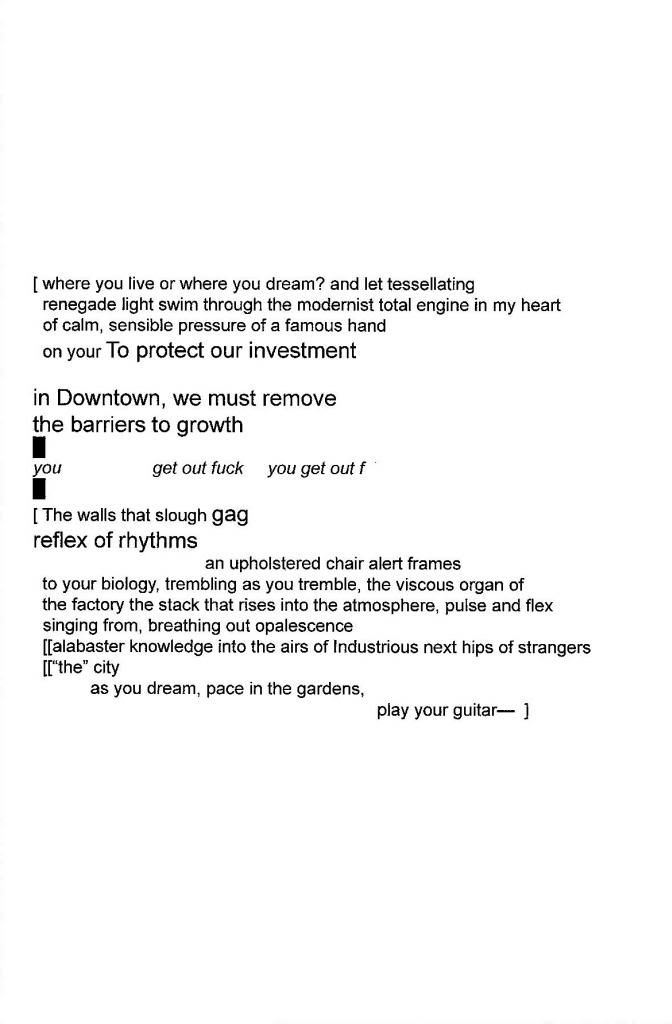
Similarly named, the authors Joe Hall and Chad Hardy market their collaboratively written collection, The Container Store (Springgun Press, 2012), as a “product,” not a book. While the tag is certainly ironic, the collection is most appropriately labeled a conceptual poem that investigates the “poetics 0/ [of] space” in consumer culture and book design.

To begin with, Hall and Hardy write that “SPACE / should be an inclusive // stationary gulf,” but soon concede that now “Space is a product. [ ] / the clear plastic // panels keep everything / visible.” On the one hand, space should be an “inclusive gulf”: a universal abyss in which everyone can be surrounded or enveloped; on the other hand, companies such as The Container Store have transformed space into a “product” that holds our “everything” elses, which are also products. In other words, a physical and psychic dimension that once had the ability to induce deep thought or sublime sentiments has now been manufactured and sold to consumers as another base and unimaginative item.

Of course, it’s not only consumer culture that systematized and marketed space. Poets and publishers of poetry, generally speaking, accomplished the same task. Most books and journals today contain left-justified, lineated verse that uses standard fonts and enumerated pages. Obviously, there have been many exceptions to this rule over the years: William Blake’s Jerusalem, Susan Howe’s Thorow, Joshua Clover’s “Ça Ira” (and other concrete poems), and Edwin Torres’s The PoPedology of an Ambient Language just to name just a few. But the vast majority of published poems (today and otherwise) adhere to standardized spatial and visual conventions. Yes, poets and publishers churn out a lot of “AESTH / ETIC / PATTIES.”

With these ideas, no doubt, in mind, Hall, Hardy, and the Springgun editors/designers created a conceptual poem that challenges these commonplace notions of space. Staggered alignments; multiple fonts, languages, and styles; an absence of pagination; the inclusion of non-linguistic signifiers; and exaggerated use of white space actively challenge the reader and require them to consider space as integral component of a poem. Moreover, they use space as a ground for play and experimentation. Take, for instance, the below screenshots (click on image for larger view):

PhotobucketPhotobucketPhotobucketPhotobucket

All of these page images, in one way or another, use the entirety of the page as a spatial field that undermines conventional design and informs the text. And the words, or “the voice,” of these poems accomplishes the same task by “convert[ing] all space to excess excess / dilapidated / love,” by noticing the “fluctuating patterns and…graphing them,” or envisioning “space” as a way “to protect power.” Again and again, Hall and Hardy engage the concept of space in order to demolish the “[containment / city]” built by poetry and consumerism, just as much of the poetry industry and consumerism “have destroyed works and replaced them with products.” In this sense, then, the book’s seemingly haphazard, “dilapidated,” and asymmetrical form proves to liberate the authors, editors, and readers from convention. Indeed, The Container Store was built so that we could enter its strange rooms, explore its dimensions, and revel in its off-kilter arrangements.

20 November 2012

Hider Roser

American poetry has long been a site of identity play and experimentation: a space where poets, at the best of times, can be both themselves and not themselves simultaneously. Take, for instance, the preface to John Berryman’s The Dream Songs, wherein the author writes:
The poem then, whatever its wide cast of characters, is essentially about an imaginary character (not the poet, not me) named Henry, a white American in early middle age sometimes in blackface, who has suffered an irreversible loss and talks about himself sometimes in the first person, sometimes in the third, sometimes even in the second.
Of course, Berryman was a “white American in early middle age” who had “suffered an irreversible loss” (he watched his father shoot himself, as does Henry in Dream Song 145), and many of the poems speak to actual events in the author’s life. And though he explicitly states that the speaker of these poems is “not the poet, not me,” the reader should (rightly) question the veracity of these claims. Are Henry and Berryman truly separate individuals, or does a conflation occur that, at times, renders the character and the poet inseparable?

Around the same time period Berryman was writing 77 Dream Songs (his first incarnation of The Dream Songs), Jack Spicer published After Lorca, which consists of a series of letters between the deceased Federico García Lorca and Jack Spicer, as well as “translations” of the former poet’s work. The opening letter consists of Lorca admonishing Spicer in the third person for taking on a project that appears to be a “waste” and “not worth doing.” In this letter, Spicer dons the mask of Lorca to chastise himself and tellingly write: “Even the most faithful student of my work will be hard put to decide what is and what is not García Lorca.” Who is Lorca and who is Spicer? Can we really tell the difference?

Yes, whether Berryman and Henry, or Lorca and Spicer, proper nouns serve not as a marker of specificity, but as a portal for confusion that releases protean identities, constantly shifting in order to keep the reader off-balance. To some extent, the slipperiness of who’s who within the proper noun is summed up in the concluding lines to Ted Berrigan’s poem “Red Shift”:
Alone & crowded, unhappy fate, nevertheless
          I slip softly into the air
The world’s furious song flows through my costume.
The “furious song” of the poet “flows through [his] costume” (i.e. the proper noun), evacuating a stable identity from the nominal marker that usually signals a specificity and leaving him “Alone.” But it also renders him part of a “crowded” multiplicity: a signifier oversaturated with identities.

Ben Mirov, in his second full-length collection of poetry Hider Roser (Octopus Books, 2012), enters the hall of mirrors that Berryman, Spicer, and Berrigan all entered before him, offering a distorted reflection of the poet that challenges reality and basic assumptions about identity.

The book’s epigraph, an excerpt from Mary Ruefle’s poem “Darke Body of Clowds,” first broaches the subject with the lines:
Pity the poor proofreader
who thinks the darke body of clowds
was my life. (1)
The “dark body of clowds” is not the “life” of the poet, but an ethereal and atmospheric mask that obscures our vision and insight into the author. Soon thereafter, in Hider Roser’s the third poem, Mirov echoes Ruefle’s concept, but through an image that’s antithetical to Ruefle’s “clowds”:
I live in an X-Ray
created years ago
by a boy named Ben Mirov. (8)
The reference to Ben Mirov as a third person distances the proper noun from the writer Ben Mirov. But whereas Ruefle employed cloud coverage as a trope for obfuscation of identity, Mirov uses an “X-Ray” of the self as a vehicle for trasnparency: a thing to be seen through and, to some extent, not there. Ben Mirov is nothing but a translucent image created by someone else named Ben Mirov. If these lines did not provide a “clear” enough statement that Ben Mirov might not be, exactly, Ben Mirov, then we’re reminded in the poem “For Ben Mirror” that:
You have no idea who you are.

You think you’re someone
named Ben Mirov. (22)
Ben Mirov might not be Ben Mirov, but guess what? Ben Mirror is not Ben Mirov either. No the Ben in the mirror is not the Ben of the flesh (who, as mentioned, is not Ben Mirov either). Which, of course, begs the question: Who the fuck is Ben Mirov?

One would think, logically, that to discover who Ben Mirov is, one would need to get to the core of Ben Mirov: some center wherein an “authenticate” identity would most likely exist. Hider Roser, it would appear, humorously dangles that insight in front of the reader for a brief moment during the poem “Transmission from the Center of Ben Mirov.” The poem, in its entirety, reads:
I’m looking for the feeling.
I know it’s lost inside.
I follow the path

past the crematorium
down to the beach
where a school of jellyfish

is drying on the sand.
No feeling. Nothing.
Nothing Nothing Nothing.

A big revolving door.
A fucking grapefruit.
On the beach is a cabin.

Of course it’s on fire.
None of this is real.
The road. The jellyfish.

The feeling looping out of itself
never touching the earth.
Maybe the crematorium. (33)
At the center of Ben Mirov, where a foundational identity would be expected (if such a thing even exists), the searcher finds “Nothing Nothing Nothing” and a “revolving door.” Just like Berrigan, whose song flows through him so as to produce a state in which he is “Alone & crowded,” Ben Mirov is both empty and full: he is nothing; but he is also an entrance that allows many masks to come and go, continually, and as they please. Indeed, the collection revels in this identity play.

Again and again, Ben Mirov as a protean identity surfaces throughout Hider Roser in a joyous confusion of naming for the sake of not naming. But if there is no Ben Mirov within the name Ben Mirov, where do these Ben Mirov poems come from? How can a person who does not exist write poems? The answer, it would seem, is simple; as we discover in “The Hole in My Friends Where Ben Mirov Should Be”:
Nothing perched on the edge

and reached it ghostly hand
into the void inside me
and pulled out a poem. (58)
An external nothingness reaches its ghost hands into a void within a proper noun and pulls out a poem. What could be simpler than that?

13 November 2012

Rise Up

In an interview on Stop Smiling during the summer of 2007, Matthew Rohrer addresses (although rather obliquely) the influence Romantic poetry had on his collection Rise Up (Wave Books, 2007):
I’ve always felt oddly drawn to Samuel Taylor Coleridge. When my son was very young, things began coming back to me — especially from “Frost at Midnight,” when my apartment was cold and the winter night was howling outside the poorly sealed windows. Then about a year ago I spent an entire year reading only the Romantics — their poems and criticism, and their contemporaries.
Yes, Rohrer “felt oddly drawn” to Coleridge and “spent an entire year” reading only Romantic poetry, but he mentions nothing more (at least not in this particular interview) about the effects of that year-long endeavor.

After reading Rise Up, one gets the sense that, perhaps, Rohrer does not say much more about his Romantic influence because the poems in the collection are often conflicted with regard to their engagement with this tradition. To explain, first take Wordsworth’s famous poem “Lines” (i.e. “Tintern Abbey”); it is a poem firmly rooted in a nostalgia of times past, which the surrounding environment generates. When recalling his youth spent running about the wilderness, the speaker says:
                                                           That time is past,
And all its aching joys are now no more,
And all its dizzy raptures. Not for this
Faint I, nor mourn nor murmur; other gifts
Have followed; for such loss, I would believe,
Abundant recompense. For I have learned
To look at nature, not as in the hour
Of thoughtless youth; but hearing oftentimes
The still, sad music of humanity,
Nor harsh nor grating, though of ample power
To chasten and subdue. And I have felt
A presence that disturbs me with the joy
Of elevated thoughts; a sense sublime
Of something far more deeply interfused,
Whose dwelling is the light of setting suns,
And the round ocean and the living air,
And the blue sky, and in the mind of man:
A motion and a spirit, that impels
All thinking things, all objects of all thought,
And rolls through all things.
The “aching joys” of childhood have long since passed, but the speaker does not “mourn nor murmur” over their loss. Instead, he hears the “sad music of humanity” in nature; but, when listening to this sad music, he is disturbed with a joy he calls the “sublime”: a “spirit” that imbues one with a subdued power rolling “through all things”: a melding the mind and nature. In this “interfuse[ion],” a certain nostalgia exists from which springs “sweet sounds and harmonies” that act as a “healing” agent when we’re confronted with “solitude, or fear, or pain, or grief.”

While Rise Up does, indeed, engage that natural world (thus linking it to Romanticism), its mode and tone appear to be rather different than its late-eighteenth century predecessors. In “Four Romantic Poets,” the collection’s opening poem, the speaker says:
                           If only the universe
weren’t shaped so much like me, I might change
my approach. (1)


                                                                      teach me
to hold an image of the world in me
that isn’t cracked, that isn’t bent backwards
like my toenail, catching on the bedspread. (2)
Just like Wordsworth’s “deeply interfused” spirit that binds man to nature, Rohrer’s speaker sees a “universe” (i.e. the natural world) that is “shaped so much like” himself. And what does it look like? It is “cracked” and “bent backwards”: damaged and in pain. True, Wordsworth’s spirit is sublime and filled with the “sad music of humanity,” but it is a music that, ultimately, brings relief from the hardships of the world, not a hardship itself. Not a “toenail, catching on the bedspread.” Not physical pain.

Moreover, Wordsworth envisions nature, even if it’s with a “wild secluded scene,” as a series of “beauteous forms”; the speaker of Rohrer’s “Poem Against Wordsworth,” on the other hand, believes that:
the butterfly has terrible
powers of insinuation
It cannot be trusted (11)
In Wordsworth’s “Lines,” the speaker self-identifies as a “ worshiper of Nature” who feels imbued with “warmer love” during his communion with the natural world. Rohrer’s speaker believes that nature “cannot be trusted” because of its “terrible / powers.” Yes, at very least Rise Up forwards a skeptical view of the natural world and its ability to heal us or protect us from moments of spiritual distress. And, at worst, one gets a sense that our surrounding environment can be outright harmful to our well-being.

Placing Rohrer in direct opposition to Wordsworth and the Romantics, though, proves to be rather reductive. In fact, in the poem “Winning Isn’t Everything,” we’re told:
                       Your sister said
autumn is sad, winter hurts,
but people who say things are
always wrong. (6)
The sadness of autumn and the hurt of winter are, it would appear, nothing more than the misguided musing of people who “say things” that, yes, “are / always wrong.” So if we’re told that the butterfly is untrustworthy and the world is cracked, we’re told incorrectly. But if we’re told anything, perhaps, we’re told incorrectly. So, what Rohrer learned from the Romantics (as it manifests itself in Rise Up) might, then, have nothing to do with nature. What he might have learned is that, just like the Coleridge’s ancient mariner, it’s better to do the telling than the listening.