27 April 2012

A Hotel Lobby at the Edge of the World

Toward the conclusion of A Hotel Lobby at the Edge of the World (Milkweed Editions, 2012), the speaker of the poem “How to Stop Migration” tells us that he “was once called a nature poet / by [his] mother” (78). We may never know if Adam Clay himself was called “a nature poet” by his mother, but it's easy to see how one could use that distinction to categorize him, at least superficially. Take, for instance, the following images in the poem “A Memory, Forgotten at the End of a Season”:
                                               You hear the birds swarming, 
             you hear the birds flapping their wings
just to stay alive. I know their colors from their song
                         but not their names. 
… 
                                           It is foolish to predict the weather, 
                         which isn't anything that can be held—
                         but still you try to hold it, stubbornly silent, (50)
Yes, trafficking in avian and meteorological imagery leads one to believe that Clay, indeed, is a “nature poet”; but if we label the poet as such, it's important to realize that something unusual is afoot within his natural world: this is not simply a mimetic experience. The speaker of the poem deduces the “color” of a bird through its “song,” exhibiting an extrasensory perception where sound gives way to sight. Likewise, the speaker acknowledges that calculating and documenting nature's trajectory “to predict the weather” is a “foolish” endeavor, but one that he undertakes nonetheless. Moreover, he does so by attempting “to hold it,” as if weather was something he could grasp. Again, the speaker experiences a derangement of the senses, communing unnaturally with nature so as to produce an oddly dislocated landscape.

But Clay does not alienate his audience by immersing them in a completely foreign world; instead, it seems, he bends the contours of the familiar so they are both recognizable and misshapen. For example, in “Natural History” we encounter the following passage:
Centering yourself along unrecorded boundaries,
it's only when you come upon
a creek in the woods that the concept of remoteness 
             dawns on you 
                          as something more than distance. 
The tree is a metaphor for something, as is the creek, as is your sightline. 
              You value landscape for the way it is both certain and changing. (6)
The recognizable but misshapen, or a landscape “both certain and changing,” offers the excitement of difference coupled with the comfort of the known. This not so much a paradox, but the poem's ability to hold within itself two contradictory positions in order to create a beautiful tension, or in Clay's words: “Centering yourself along unrecorded boundaries,” which contains both an anchored focal point and an unmapped margin.

And what of the tree and the creek, which are both “a metaphor for something” else? It would not be a overreaching to claim that they are, in the poem, not only constructions of the poet's mind, but reflections of the poet's mind. Given the aforementioned dislocated landscapes, then, it should come as no surprise that the speaker of these poems declares:
         I am beginning
to think a fragment
is as complete as a thought can be. (38)
Fragmented thought produces fragmented landscapes. But even this fragmentation proves to be ephemeral, as we wait “in anticipation of a fragment breaking down” (43), when all our broken discoveries become “more like a dream // than reality” (54) and reveal that the poems, the words, “the symbols add up...[to] nothing” (72) but the echo of a “splash unseen” (73). And so this nature poet fractures, then dissipates, into a complex landscape where the “weather grows less stable / than us” (3).

25 April 2012

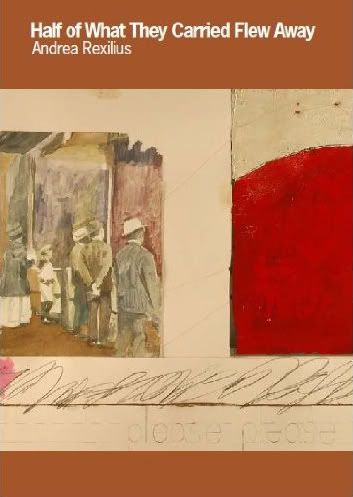
Half of What They Carried Flew Away

In a 2011 interview on Book Slut, Andrea Rexilius mentions that the conceptual genesis of Half of What They Carried Flew Away (Letter Machine Editions, 2012) stemmed from, in part, essays she taught in a composition class “on ways in which marginalized voices speak up to interrupt, or just to enter, and comment on or critique or call out or make visible a perspective previously shut out or unheard within the cultural narrative.” Not surprisingly, then, the tropes of boundary, crossings, and transformation employed by Rexilius echo those found within Gloria Anzaldua's Borderlands/La Frontera: The New Mestiza, a foundational text for marginalized voices in the twentieth century.

Joan Pinkvoss, in her introduction to the third edition of Anzaldua's book, describes Borderlands/La Frontera as an “inclusive, many-voiced” (i) text that highlights identities “caught between los intersticios, the spaces between the different worlds” (iii). Similarly, in Half of What They Carried Flew Away, we find:
Furrows are created by circumstance. A type of fluid to recognize transformation. The above does not impose. Inner changes played out in outer terrains. Nothing happens to the image. These borders they live on, interrelated. (35)
The confluence of “inner changes” and “outer terrains,” or the “border” on which they “interrelate,” comprise a zone of transformation wherein identity becomes “fluid.” Rexilius's collection concludes with:
I do not know what it is I am like.

I am above all flight from flight.
I undertake not to represent, interpret or symbolize, but to make maps and draw lines

I am neither a woman nor a man in the light. (89)
The speaker draws maps, escapes along lines of flight, is “neither a woman nor a man,” and admits that “I do not know what it is I am like.” To this extent, the non-gendered voice explores a mutable concept of self and participates in a “shaman aesthetic” wherein the storyteller transforms “into something or someone else” (Pinkvoss xviii); or, in Anzaldúa’s words, enters into “a place of contradictions” (19) located “at the juncture of cultures [and] languages” (20).

The most evident instance of a shaman aesthetic within Half Of What They Carried Flew Away occurs during one of the book's few image-laden passages:
They needed a language to communicate with themselves.
They put bones, pieces of bark, feathers into a tape recorder.
The meaning of the word forehead came out.
They come to the open between each breath.
They breathe out, grow gills and a river pours out.
Storms dissolve in their saliva.
They look up at the vast terrain, They've crossed over. (84)
The transformation of bone, bark, and feather into forehead; or the human body, replete with river water, growing gills: these physical alterations for the sake of “communication” signal an arrival at Anzaldúa’s “place of contradictions” where nature and culture, among others discourses, intersect.

Of course, there are differences between these texts. For example, Anzaldúa claims that the U.S.-Mexican border “es un herida abierta where the Third World grates against the first and bleeds. And before a scab forms it hemorrhages again, the lifeblood of two worlds merging to form a third—a border culture” (25). Not only is this border inextricable from the body, but it is a body bleeding, scabbing, and bleeding once again. In contrast to Anzaldúa’s border as flesh, Rexilius writes:
A sea they say an origin.
I say sea, a place of incest. Holding something at bay.
Place where land and water meet. Bilingual place.
Place of water. Bodiless body. (21)
The confluence of elements, the border between land and water, is a “Bilingual place” just as Anzaldúa posits la frontera to be; but Rexilius's location is “Bodiless.” The speaker reinforces the absence of  a body later in the collection, when she writes: “I have been told, it is unfair to say the word 'body' again. That's fine. It's easy enough to ignore” (35). One writer believes the body to be the epicenter, literally, of the new mestiza consciousness that must be “enacted” and “forever invoked” (89) in the flesh, whereas the other writer chooses to “ignore” the body.

Why, then, does the speaker of Rexilius's book promote material absence at a border? The answer, perhaps, can be found through a question Half of What They Carried asks of its readers: “What is the emanation of the image?” (23), where the image is a body inscribed. For the speaker of these poems, what emanates from the image is “contamination[,] a condition” (25) which produces “a cruel second nature” that places “limits” on one's “distinctions” (26). Accordingly, when a writer “decrease[s]...the images” within her writing, which for the most part Rexilius accomplishes, an “expansion” (49) results through abstraction. Abstraction, conceptualized in this manner, engenders a more protean and, thus, more egalitarian text that creates a fluid subjectivity. Subjectivity, as such, moves with less difficulty across borders, clearing a space for marginalized voices and a critique of dominant narratives.

16 April 2012

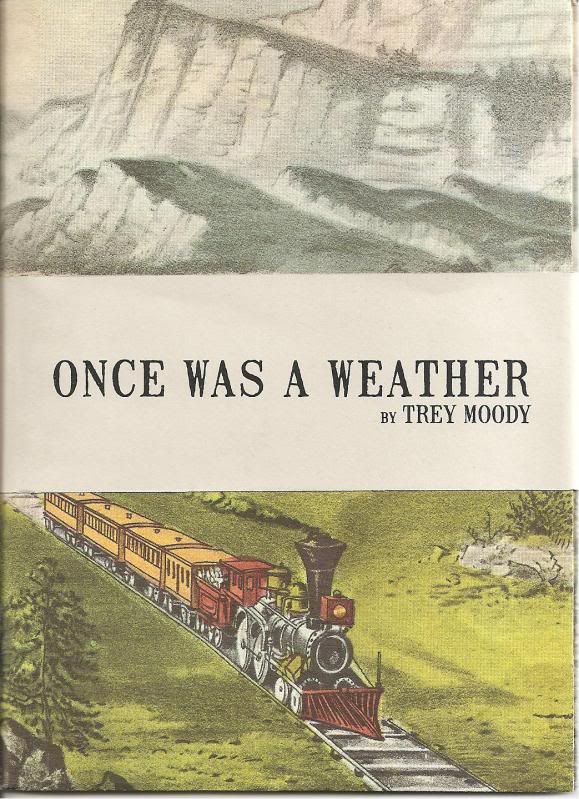
Once Was A Weather

Trey Moody's chapbook Once Was A Weather (Greying Ghost Press, 2011) contains a sequence of prose poems, each one titled “A Weather.” We frequently speak about the weather, but rarely do we consider a weather. By preceding the word “weather” with the indefinite article instead of the definite article, Moody challenges us to consider language's minutia and its effects upon the reader; in many ways, such an engagement echoes Louis Zukofsky's belief that the poet must give “some of his life to the use of the words the and a: both of which are weighted with as much epos and historical destiny as one man can perhaps resolve” (Prepositions 10).

Such an attention to article usage, between the definite and indefinite, signals a highly attuned relationship with language: word combinations are not chosen in a slapdash manner, but “weighed” with the most exacting precision. In the below video, Moody reads a poem from his “A Weather” sequence for the Route 7 Reading Series at Dixie State College in St. George, Utah on 12 April 2012:


Zukofsky's resonance can be heard at the poem's outset, when Moody asks “Why a,” thus confirming his interest in article usage and a willful, Deleuzian “stutter” between “every position of a or the” that constitutes “a zone of vibration” (Essays 109) Of course, to not consider such linguistic matters, at least for the poet, eventuates failure; Moody makes this clear when he says: “Why weather becomes a lack—language suffers, like you.” While this sentence can be interpreted in several ways, we can read it to mean that “Weather,” when stripped of both indefinite and definite article (i.e. an “a” lack, or a “the” lack for that matter) suffers because it refuses to enter a vibratory zone; thus, its “Music wanes.”

Here's Moody reading another selection from his “A Weather” sequence for the Neon Lit Reading Series in Las Vegas, Nevada on 13 April 2012:


Indeed, these prose poems are “Complex countertops” that frustrate the reader if their access point is meaning, or “Information's information.” But the “lack of insight” is only lack if readers attempt to enter the poem, primarily through the meaning-door; if a reader, like the “Wind,” simply “listens,” then access to these poems becomes much easier.

To further extend the relationship between Zukofsky's poetics and Moody's “A Weather” sequence, consider the following excerpt from Charles Bernstein's introduction to Prepositions +; to his mind, sonic elements:
Do not accompany meaning, neither are they arbitrary nor conventionally associated with meaning: they make meaning. When words are heard as sound, the poetic mode of expression has taken hold. The result is…an acoustically charge poetry…derived from the newly invented. (ix-x)
Yes, sound in both Zukfosky and Moody create meaning and thus produce an “acoustically charged poetry” emitting an atmospheric music ready to be absorbed by the reader.

15 April 2012

Sons and Followers

The fact that Matthew Klane's chapbook Sons and Followers (Self-Published, 2009) praises a “mawky wormbent / whiskey babble” and focuses on men “yammering animal / hosannas” might lead readers to believe that the speaker of these poems embraces an uncouth and primal use of language; such an assumption, though, would be anything but the case. In fact, the poems within this collection challenge us to abide by a strict imperative:
Build your speech
piece by piece.
Be precise—
Be deliberate—
Fortify
the mortices,
constrict
your force-of-habit.
In other words, this first stanza of the poem “Beecher's Bible” asks us to construct a specific linguistic system that, through an overtly conscious engagement with its component parts, produces a well-wrought end-product. The importance of these instructions cannot be undervalued, and the collection repeats the message in varying forms from poem to poem. Whether addressing a poet's need to direct the rhythms of a poem via the metaphor of the horse and wagon:
The hollow clop of
horse-hooves
follow
the whip
follow
the wagon.
Or the use of a particular diction via the metaphor of the sheepherder:
we shepherd the words
chattel, dominion, value,
fair sex.
Sons and Followers forwards a belief that while poetry contains a certain “naturalness,” poets must construct, pace, and herd their words within a particular poetic or language usage in order write passages that contain an economical beauty, such as:
Blue
sky's the limit, it's
cyan silo's airy cupola,
acres of billowy
loam.
Klane's constructivist stance is not limited to his poetics though; it also seems to guide his conceptualization of bookmaking. (Given that he is the editor of Flim Forum Press, it's only natural he would put pressure on the collection's materiality.) The cover of Sons and Followers, for instance, contains no title or author name, merely the image of a vertically-aligned, black rifle in the lower right-hand corner against a lavender background. Such an omission leaves readers absent of some basic information regarding the artifact in their hands. Midway through the collection, the poem “Master Narrative” provides us, perhaps, with the conceptual underpinning of this decision:
Life is
rebellion and retribution.
Rifle the referents,
then, purge definition.
The verb “rifle” reminds us of the pictographic representation of the noun “rifle” printed on the cover, and thus coaxes us into developing a relationship between the two instances. Specifically, the choice to exclude the book's primary identifiers from its front cover acts as a “rebellion” against bookmaking's master narrative, thus robbing (i.e. rifling) the collection of its most elementary “referents,” purging it of self-“definition” and forcing us to rethink the production of the artifact itself.

11 April 2012

Route

Route (Immaculate Disciples Press, 2012), the most recent collaborative chapbook by Julia Cohen and Mathias Svalina, contains two poem sequences: “Black Metal & Ice” and “Two Sisters.” The poets composed the first sequence as a series of twelve, relatively short prose poems; they wrote the second sequence in prose as well, but as one long piece without internal titles dividing it into smaller subsections.

The poems in “Black Metal & Ice” tend to be “Fragmentary & obscure” exploring the “infernal regions [and] southern most caches” (13) of the poets' minds in order to create a shared “terra firma” (13), or solid ground, which is populated by such images as “a man of straw & scurrying alarm & a letter iced with waiting & livers of goats” (10). Take, for instance, the opening poem “Natural Death,” which provides an example of one such ground:

The boys twine a garland for judgment & the girls another for the heroic age. Scientific bodies presume something similar to the sound of breaking glass, the power of laying the storm. It is precisely the persons most intimately concerned with blood who are quiet detractors, who damage the explorers' reputation. The storm. The storm abandoned by blood. Outwintered by secrecy, all who meet drop their faces to the earth. The crew, betrayed by large maps, returns to exile. And if they were to die a natural death, pleased with their last words, the after is still the storm. (7)
Although the subjects of the poem “die a natural death” and they are “pleased with their last words,” the poem concludes pessimistically, at least in the sense that a “storm” still rages. The intimation of cataclysm brought on by a storm lingers throughout the sequence in the form of “famine,” (9), “The isolation of a heavy meal” (11), and “a bad heart” 12); indeed, it would appear that “Defeat is certain” (16). But the poets, ultimately, provide readers with a possibility of hope. Within these fractured and “Misshape[n]” (18) vignettes, “Occasional relief crosses” their “unknown surface[s]” (12) and results in a “victory” (18) of poetic impulse, the imagination, and collaborative spirit.

“Two Sisters” follows a more straightforward, but still relatively oblique narrative about, yes, two sisters. The poem begins with the sisters floating on an umbrella “in the ocean's chop” (21) where they “read all the great books & perform them in the bruised sea air” (22). We soon discover, though, that the siblings are on a journey to “the city to find the man who paints the pictures” (25). After arriving at and traveling through the land where they encounter temples, scientists, and caves, the sisters' desire for adventure is “sated” and “they leave in the brick boat” (30).

But even with this loose narrative structure, “Two Sisters” is more painting than story:
Sitting on the chapel steps, the man who paints the pictures braids the pictures together for a bed sheet. When he sleeps the pictures tell each other how they met. They become families, winding themselves into linen. (25)
The above excerpt can be read, to some extent, meta-poetically: the prose poems are braided together by two poets, perhaps from “pictures” or dreams that come to them while they sleep, the fragments of which are found upon waking in the bed sheets and linens. The leftover “pictures” found upon waking allow for them to “crawl inside [the] echoes” (29) that remain and preserve the memory of “how they met.” But more important to this collection, it would seem, is the braiding-effect that the collaborative process offers. While exploring “the dim frontier” (23) of poetry, integrating multiple perspectives into a poem creates a more expansive vision because: “The smaller sister sees everything from the feet to the waist” (24), whereas “The larger sister sees the pictures from the waist up” (26). Through braiding their visions, the poets offer us a more complex and complete picture.