13 October 2016

Bloomfield, Foley, and Xu Read Poems

This article first appeared as a post titled "Best Thing I’ve Heard Today: Bloomfield, Foley, and Xu" at Vouched Books on 20 March 2014.

Last night the poets Luke Bloomfield, Brian Foley, and Wendy Xu passed through Cleveland, OH on their Moonbucket reading tour in promotion of their books Russian Novels (Factory Hollow Press, 2014), The Constitution (Black Ocean, 2014), and You Are Not Dead (Cleveland State Poetry Center, 2013), respectively. Below are three short video clips of each poet performing at the event, which took place at Guide to Kulchur.

Here's Luke Bloomfield reading his poem "Fisticuffs":


Here's Brian Foley reading his poem "Acumen":


Here's Wendy Xu reading here poem "Nocturne":


Their tour, which has also taken them to Philadelphia, Baltimore, and Akron, will continue tonight in Buffalo, NY.

Dave Lucas Introduction

This article first appeared as a post titled "Best Thing I’ve Heard/Read This Week: Dave Lucas" at Vouched Books on 10 March 2014.

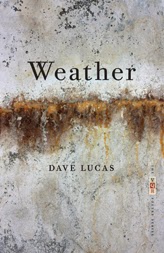
Weather After a month-long layoff, the Poets of Ohio reading series resumed, hosting Cleveland-native Dave Lucas. Lucas read and discussed poems from his debut-collection Weather (University of Georgia Press, 2011) to a large, hometown crowd last night at Case Western Reserve University. Below is an excerpt of the introduction I gave for the event:

The history of poetry in and of Cleveland is fraught with complex tensions between poet and city. In a letter dated 15 June 1922, Hart Crane, arguably Cleveland’s most famous poet, wrote to his friend Wilbur Underwood that “Life is awful in Cleveland.” In the recently published anthology of his writing, the poet Russell Atkins focuses his creative imagination on the “miserabled gone” of Cleveland and its images of the “sick / against [the] broken.”And, d.a. levy, another local yet nationally-known poet, wrote:
cleveland, i gave you
the poems that no one ever
wrote about you
and you gave me
NOTHING
While, no doubt, it’s easy to promote a narrative of Cleveland within poetry and the arts that is filtered through such a negative lens; there also exists an alternate vision that forwards a place-based poetics which champions the city in all its oxidized glory.

Dave Lucas’ first book, Weather, I think, traffics primarily in this latter category. While the speakers of his poems do acknowledge the “dying arts” (1) and the “muddy unmarked grave[s]” (14) of industrialism, they also articulate a relentless determination by the city and its inhabitants to persevere. For instance, in the poem “River on Fire,” Lucas meditates upon the burning of the Cuyahoga River, concluding with the realization that the “river burned and was not consumed” (15). Yes, it was set aflame several times—13 times, to be exact, from 1868 to 1969—but the river remains. And now, due to recent environmental efforts, the Cuyahoga is cleaner than it has ever been during the past 150 years.

In an interview I conducted with Lucas a little over a year ago, he mentioned that he hoped the poems of Weather would work through the tired narratives of “apocalypse and exodus” that so often dictate conversations about Cleveland in order to “transform” our collective imagination of and about the city. Rather than an urban landscape of decay, the poet wants “both [his] art and [his] city to be…in the present tense”: alive, vibrant, and worthy of praise.

To this extent, then, the poems of Weather mirror rather closely the poet Richard Hugo’s concept of the “triggering town,” wherein the “initiating subject”—in this case, Cleveland—activates the “imagination” in order to yolk intellectual curiosity, emotional resonance, and aesthetic beauty at the site of the poem.

Yes, the poem becomes a place both to embody and honor another place; and this doubling of place within Weather serves as a poetic reminder that Cleveland is not dead. Instead, the city is, indeed, “present” and thrives in our presence; perhaps under a layer of rust, for sure, but it lives and flourishes, exuding a passionate intensity that belies the negative critiques outsiders so often foist upon our city.

Here’s a video of Lucas reading his poem “Midst of a Burning Fiery Furnace” from the event:


This Thursday, 20 March, the poet Daniel Tiffany will deliver a hybrid reading-lecture titled "Is Kitsch Still a Dirty Word?"; and on Thursday, 27 March, the poet Tyrone Williams will read and discuss his poetry. Both events will be held on Case Western Reserve University's campus.

Jennifer Moxley Reads "No Place Like"

Thi article first appeared as a post titled "Best Thing I’ve Heard This Week: Jennifer Moxley" at Vouched Books on 06 March 2014.

A couple of weeks ago, the poet Jennifer Moxley flew in from Maine to vist Case Western Reserve University's campus in Cleveland, OH.

On 20 February, she led a group discussion that focused on her article "A Deeper, Older O: The Oral (Sex) Tradition (in Poetry)," which is forthcoming in the Jeffrey Robinson and Julie Carr edited Active Romanticism, (University of Alabama Press, 2014).

The following day, Moxely read poems at an event, performing mostly new material that will appear in her forthcoming collection The Open Secret (Flood Editions, 2014).

Below is a video clip of the poet reading her poem "No Place Like":


To find more of Moxley's work, click-through to Flood Edition's website.

For those in the northeast Ohio area, Dave Lucas (03/18), Daniel Tiffany (03/20), and Tyrone Williams (03/27) will all read at Case later this month.

Abide

This article first appeared as a post titled "Best Thing I’ve Read This Month: Abide" At Vouched Books on 03 March 2014.
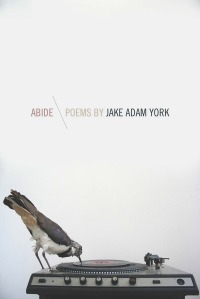
York From 2004-2005, I was a graduate student of Jake Adam York’s at University of Colorado-Denver; I also worked as a poetry editor with him on some early issues of Copper Nickel. Having known Jake personally and being familiar with his dedication to and enthusiasm for all-things poetry, it was heartbreaking to hear of his untimely death just over one year ago.

After recently receiving a copy of his posthumously released Abide (Southern Illinois University Press, 2014) in the mail, I was thankful for the opportunity to read new work by him; but that thankfulness was tempered by the sadness of knowing that he is no longer with us.

Abide serves to reinforce these conflicted feelings. On the one hand, the poems demonstrate York’s deft musicality, attention to craft, and adherence to an ethical imperative that originates in the historicity and spirit of the Civil Rights movement. On the other hand, the elegies therein resonant with sadly, prophetic echoes that often times seem to prefigure his own passing.

The poem “Mayflower,” for instance, is an elegy composed for John Earl Reese, who the poem’s dedication mentions was a “sixteen-year-old, shot by Klansmen through the window of a cafĂ©” on “October 22, 1955.” The opening lines read:
Before the bird’s song
you hear its quiet

which becomes part of the song
and lives on after,

struck notes bright
in silence (17)
While, certainly, one can read the passage on the surface level as a lament for Reese’s passing, it is not difficult—at least for this reader—to read these lines as premonitory: “Before the bird’s song,” or the release of the poems in Abide, all we can “hear” from York is the “quiet” or “silence” following his death. Upon publication, the effects of his death become “part of the song,” at least to the extent that the poet’s absence can be keenly felt (or read) in all of these poems.

As the poem proceeds, the speaker eventually levels an awful truth:
and a young man’s voice

becomes a young man’s
silence, all

he did not say (18)
Yes, in the poems of Abide we hear the “young man’s voice” singing for us once more; but inherent to this music is the realization that the collection will be followed by the “young’s man’s / silence” and “all // he [will] not say.”

And one can only assume that York had much more to say. In the book’s concluding “Foreword to a Subsequent Reading,” Jake writes that his project of creating poetic monuments to the martyrs of the Civil Rights Movement was, indeed:
always too big for one book. It is more complicated than a simple serial form, like a trilogy. It is the work of a life, both countless and one; one cannot predict how long it will take, but it will take as long as it will take. Abide continues, advances, event as it contains, as it remains. (79)
While the completion of his project might not have reached full fruition, the four books York released do serve to “elegize” at least some of the “men, women, and children who were martyred between 1954 and 1968 as part of the freedom to struggle” (79) in a beautiful and earnest manner. Such elegies, it would appear, stem from both explicit and implicit prohibitions against articulating and celebrating these victims. Or, as the poem “Letter to be Wrapped around a 12-Inch Disc” states:
                                   We had so much
behind us, the history

               we were told we shouldn’t
name, stir up, remember,
                              so much silence

we needed to break (11)
York’s poems, specifically the elegies, seek to rupture the “silence” by stirring up and remembering those names that others wanted to be left behind and forgotten in the forward march of history.

To this end, York understood the necessary connection between memory and naming bound within breath: “We visit memory sites…but if memory lives on there, it isn’t memory anymore. Memory lives in the breath we breathe, in the air we make together” (80). We should, then, take this to declaration of breath to heart in order to keep both the memory of Civil Rights’ martyrs and York alive.

To do so, though, requires more than a visit to the physical site of a memorial or purchasing a book artifact. Rather, we must sing the names of the deceased through the silences. We must voice the names and recite aloud the poems, such that we begin “reaching / for the sound of some beyond” in order to create a “vibration” (8) that awakens the spirits and brings them to life through the audible word. Doing so will, in the end, reactivate the “Last breaths of the disappeared” (36) at and in the site of the poem. Or, as Jake himself wrote:
Maybe we keep saying
their silences between our words,

the shape of their voices
in ours, in ours

the warmth that haunts
their absent lungs. (34)
And, indeed, by reciting the poems of Abide aloud while reading, the reader shapes York's voice within their own voice, such that the poet's memory haunts the lungs of another, imbuing the breath and body with the spirit of the deceased.

Best Poems

This article first appeared as a post titled "Best Thing I’ve Read Today: Best Poems" at Vouched Books on 24 February 2014.

MKBPWebCover3 Recently, Big Lucks (in conjunction with Narrow House Editions) published its first, official release: Mike Krutel’s chapbook Best Poems.

The poems in Krutel’s chapbook (which is, incidentally, his first, official release as well) wander from line to line and image to image in strange, half-lit worlds; or, as the speaker of “Best Picture of Me in a Tub of Rotary Phones” says:
You keep me waiting,
grown man that sleepwalks his
way down a well to linger. Wandering
full of worlds. I don’t know
where to turn or if there’s any
way out of this mirror. (22)
Yes, Best Poems often reads as if it were the secret dream journal of a somnambulist “Wandering” through “worlds” filled with words; and in this world of language, both the speaker and the reader become lost in a playful labyrinth of “mirrors” so that they “don’t know / where to turn” in order to escape.

Of course, why would you want to escape? Because, indeed, getting lost within these poems ends up being a lot of fun. Take, for instance, the opening lines of the collection’s first poem, simply titled “Best”:
Tonight is night of no sleep.
Cannonballs over the playground.
The cat rubs a glass frame off the mantle.
Somewhere there is a woman, comfortably lost
inside a small idea. You are that woman
and above you are your own best guesses.
How the vehicles are doing real things.
How the sun shoots its umbilical light around,
straight into night. There is sound outside.
It could be dandelions screaming
like engines or the causeways between
us. You are a small woman. I am holding
these individually wrapped letters
between the scaffold of my ribcage. All indications
say I should know better by now. (1)
Like the somnambulist before him, the insomniac in the “night of no sleep” encounters an equally strange, half-lit world during the hour of the wolf. Haunted by both the surreal (e.g. “dandelions screaming”) and the mundane (e.g. “The cats rubs a glass frame”), the sleepwalker and the sleepless, the speaker and the reader, all become “comfortably lost / inside a small idea,” a small image, and a small world made up of the “sound outside” ourselves.

While they might concede to (or revel in) their waywardness, the speakers of these poems continually attempt to make sense of their worlds as they are led further astray by the night. And that sense comes by way of internal arrangement or some abstract, organizing principles of the poems; we're told as much in the following passages:
I am with difficulty
rearranging patterns of static
that ferment around
our little heads. (10)


The moment became always
a reassembly of everything
different from everything, which is was. (21)
Of course, these and other “requirements for adequate reintegration” (14) are, perhaps, a bit of a dodge. For, in fact, if they serve a determinate purpose, it is not actually to access sense or plan an escape; rather, these alternate arrangements serve to ratchet up the playfulness of these poems, which, at night, glow beneath the “ambiguous moon” as it “does its dirty thing” (10).