18 February 2013

American Dialectics

One corollary of conceptual writing, following Sol LeWitt, maintains that “the idea or concept is the most important aspect of the work” and that “the execution is a perfunctory affair.” Hence, in its purest and most rigorous application no writing results at all: the concept alone is worth contemplation and would only be determined in its execution. Another corollary maintains, to the contrary, that writing resulting from the execution of a concept or procedure should itself be at least as interesting as the concept or procedure. From this it follows that value inheres to concept or procedure chiefly insofar as it yields compelling, engaging, interesting writing. I intend my review of American Dialectics to operate somewhere between these corollaries. I want as much as possible to collapse this very distinction and make the concepts and procedures an integral part of the very material occasion of the text’s being.

Yes I am a poet, truly, and I was struck dumb, stammering, attempting to speak in the presence of your glance. Shall we talk? In faith and in hope, I am listening.

I can certainly imagine procedures to obtain the circumspection of my pleasures. The business of coiling, rattling, and spitting. This describes the situation obtaining. Somebody else did it before we did it. I am nowhere gathered together. I recognize that scene of language. Do you remember shape-shifting? It frees the air of dead influences. I am transported, beyond language, i.e., beyond the mediocre, beyond the general. I can do everything with my language, but not my body. And no silence exists. I am not interested in my mind. Music is not different only simpler. Now that things are so simple, I hear rumbling menacingly a whole other world. I engage in dialogue, to the point where I lash out furiously against the importune outsider who wakens me from my delirium. “We have three”: the close anonymous collaboration. I perform, discretely, lunatic chores. I am caught up in a double discourse, from which I cannot escape. I sustain this discourse. We will change direction constantly. Phrases begin and end. I want, I desire, quite simply, a structure. Does it matter which? 

If one hears what one writes—by which I mean not just paper poems—how can one not be seduced by the sensuality of the language? It is physical, very exciting, and when organized it can have the impact and grandeur of Wordsworth. The struggle is between this sensuousness which is elegance and the newer, easier to arrive at, excitement. On the one hand language is comprehensible in that it evokes a sentiment, though the sentiment itself may be incomprehensible and far reaching. Language is all our dreams of poetry. Non-referentiality is poetry’s dreams of us. And those moments when one loses control, and language like crystals forms its own planes, and with a thrust, there is no language, no idiom, no sentiment, nothing left but the significance of our first breath.

I love splitting and scuttling American Dialectics. You go crazy traveling through logic, blaming it all and fucking over in ya. Words, terrible scuttle. You like his alright. Move over if talk can grab ya. No trust can doubt you.

“A Conceptual Review of American Dialectics by Tom Orange” is a treatment of Tom Orange’s American Dialectics (Slack Buddha Press, 2008), conceived of on 16 February 2013, actualized on 17 February 2013, and performed on 18 February 2013. Each paragraph of this review contains language taken from a particular piece of conceptual writing found in the original text. The original text contains seven compositions, five of which Orange actualizes/performs and two of which remain conceptual.

11 February 2013

O Holy Insurgency

Of her second full-length collection of poems, O Holy Insurgency (Black Lawrence Press, 2013), Mary Biddinger writes on her blog that the book:
wrenches the love poem out of the terrain of hearts and flowers, and transplants it in a quotidian rust belt paradise, where broken glass becomes a shimmering beacon, and no river is too polluted to dazzle a pair of lovers on its banks.
To call O Holy Insurgency a collection of love poems would, indeed, be correct. For everywhere throughout its pages, an “I” and “you” travel through Biddinger’s “rust belt paradise” in an effort to join as “we” and “us.” Take, for instance, the opening lines of the poem “Treaty Lines”:
There were wonders, but we didn’t know
they were wonders, or that they belonged

to us. The watermelon we tethered in a maple
with fishing line, just to see who would look up.

A dare involving teeth. Sentences we’d write
to burn. I trade my fear of matches for a love


There’s a filament inside both of us, though
we never noticed. It’s imaginary most days. (17)
Tethering a watermelon to a maple tree with fishing line or proposing an unnamed dare involving teeth are just a few of the unknown “wonders” to which the book’s couple find themselves subject. These “wonders” create an “imaginary” and unacknowledged “filament inside both of” them that bonds the two in a love burning through Insurgency’s sentences; yet it leaves the imaginary filament intact.

The imaginary filament connecting these lovers is of utmost importance because the “rust belt paradise” they wander through constantly shifts, mutates, and conjoins, thus making it easy for one to get lost in it. Or, as the speaker of “A Diorama” says: “One day / we woke to an unfamiliar backdrop” that “took weeks for them to identify” (70). Yes, just as the fishing line tethers a watermelon to a maple, the filament tethers the lovers together throughout the “unfamiliar backdrop.”

As long as the imaginary filament keeps the lovers attached, the protean landscape of Biddinger’s collection does not instill anxiety or fear. Instead, both lovers and readers can delight in the collection’s fabulous permutations, such as when the speaker sees “you walking out / of the sea instead, except we only had lakes” (13); and each “lake engulfed another lake” (53) with “clouds / turning green overhead” (35). Similarly, the speaker and her beloved eventually:
       invent an ocean, then merge
the ocean with another ocean
to make it vaster. (26)
or a day when:
Autumn and spring fused to one
single season where the leaves died
and reopened, and then died again. (65)
Or how:
             Somewhere nearby, two
doves stood tail to tail, made one

four-legged blur. (68)
Whether a sea transforms into a lake, an ocean into a large ocean, or autumn and spring merge into some unknown hybrid season, the “I” and “you” do not separate. They do not lose themselves or their love.

Of course, all these alterations eventually do affect the lovers themselves, such that “Every night we remake us / as our skin transubstantiates” (60). Yet even with the external transformations the “I” and “you” undertake, the filaments inside of them keep them attached; and whatever distance does separate them, they carefully map and document so as not to lose their bearings:
                                         Detail
the inches that might exist

between us, as if anything
could. (58)
The “inches the might exist / between” are so few that the speaker’s map of O Holy Insurgency’s strange world “become[s] // the palm of your hand. No longer / hiding your body from mine” (69). As such, with these maps, the lover’s bodies remain close. They keep the lovers familiar to one another. Or as Biddinger writers toward the conclusion of the collection:
Everything with us had a certain

permanence the rest of the world
lacked. The only place for me

was poured across your body. (85)
Indeed, even when liquid and fluid, the lovers pour their bodies across one another and remain fused in their love. Their imaginary filament connects them permanently, while “the rest of the world” in the rust belt paradise shifts, changes, or disappears.

04 February 2013

Hélène

The first epigraph of Hélène (Furniture Press Books, 2012), Deborah Poe’s novella in verse, is an excerpt from Michel Foucault’s Discipline and Punish. It states:
moving still farther away from penality in the strict sense, the carceral widen and the form of the prison slowly diminishes and finally disappears altogether: the institutions for abandoned or indigent children, the orphanages, the establishments for apprentices; still farther away the factory-convents…where girl workers entered about the age of thirteen, lived confined for years and were allowed out only under surveillance, received instead of wages pledged payment…which they could use only on leaving.
Conceiving of the textile industry as an invisible prison whose structure has receded from view, Foucault understood the female factory worker to be surveilled and incarcerated by a system whose shackles and bars were not wrought from iron but from a patriarchal ideology and an economics of inequality. The factory-girl’s only escape was betrothal. Marriage, of course, was not an escape at all; it was merely another form of prison.

The Foucault epigraph provides a multi-layered framework for Poe’s novella. At the level of narrative, Hélène tells the story of the title character’s life as a laborer in a silk factory; but conceptually, everywhere a language of confinement litters the text. On the opening page, Poe writes: “Forget the elastic or bounding movement. // To eliminate succession of movements is to linger in lament”; and shortly after:
Girls mummied with stares that could frighten a specter.

One girl that stuck. A gaze nerve struck.


Some wanted to run. The way they controlled themselves as they crept through space.
The restrictions of factory life force Hélène and her co-workers to forget their “bounding movement” and remain in a “mummified” state that leaves them “stuck” within a stifling social and economic system. As year after year of confinement passes, their boundaries become self-imposed through habit; yes, some “wanted to run,” but they now “controlled themselves” and could do no more than “cre[ep] through space.”

Of course, the space Hélène creeps through is not only highly regimented (both externally and internally), but limited to activities that serve either an economic function for her employers or the most basic survival requirements for herself:
Here is where you pray.

Here is the workshop.

Here is where you sleep.

Here is where you spin.

Here is where you weave.

Here is where you learn.
Sleep, pray, spin, and weave: this is what the factory girl learns; thus, this is what the factory girl knows: a life committed to the production of silk garments with occasional moments for rest and religion. The most frightening aspect of Hélène’s invisible incarceration, though, is not the scope and range of these restrictions, but the fact that the psychological torment incurred upon her and her co-workers succeeds in transforming their thought:
The benefactor offered something other than work on farms.

The benefactor set out to board, lodge, and clothe girls as well as give them wages.

The benefactor built the silk factory.

The benefactor taught the art of silk.

No, the benefactor taught the manufacturing of silk.

The benefactor became the hero of the country.

The benefactor found docile bodies.
Her captor transforms from a de facto prison warden into a “benefactor” and a “hero of the country.” Moreover, echoing Foucault, her once individuate or liberated self transforms into a “docile body” that can be manipulated at will for the sake of “manufacturing silk” for someone else’s profit. Yes, the most dangerous prison is not a fortified structure with locked cells and high walls, but the mind broken into subservience.

Poe’s Hélène provides flashes of hope for the title character as the novella nears its conclusion, though, as she begins to take control of her own body by employing it for her own artistic ends:
I crush my chest and pull out a string of songs

bone inscriptions, note on a score—in the rights hands something becomes

music—these are the notes which code a becoming

phenomena maneuverings otherwise left unscribed.
While, yes, Hélène must enact a certain violence upon her own body in order to escape her various captors, she does so in order to “pull out a string of songs” from inside herself and create a “music” of her own. True, her “becoming” commences with her crushed chest, but the self-inflicted damage enables her to enact a series of “maneuverings” that would have other been unavailable to her. Soon thereafter, Hélène concludes with the protagonist traveling “miles and miles” with “a book of songs” into an unknown future away from her invisible prison. The hope of liberation, it would appear, exists in distancing herself further and further from the prison structure and found in the possibility of song.

28 January 2013

We Are Pharaoh

Robert Fernandez’s debut collection of poetry We Are Pharaoh (Canarium Books, 2011) opens with the poem “Polyhedron,” which by definition is a multi-surfaced, three-dimensional object; or, as the poet himself writes, “2,700 intersecting tiles.” As an added twist, though, Fernandez’s polyhedron contains the uncanny ability to emit “cosmic background radiation,” enabling him both to “highlight sound” and “fall back into the life of a painter” (3). To this extent, the polyhedron can be employed as an apt metaphor for the poems in this collection: a series of intersecting and multi-layered tiles that delight both through sound and image. Take, for instance, the following excerpts from the aforementioned poem:
Speed and seeing are the only requisites
to positioning oneself in tradition

or catching rhythm
bare chested, youthful (4)


The eye is present if the rain is out,
threatens to bend not only reeds

but pitch, guitar, eggs of the macaw
Not just the river but the shadow of the river travels (5)


as a pearl Ferrari approximates
the angel of history,
so our mourners shy off
into flatness and ice (12)


tomorrow beauty shifts its name,
swallows landscapes,
rivers—

the seams vanishing across that discourse (13)
These four sections are indicative of the thirty-six sections of the poem: short intersecting tiles that catch a “rhythm” that harnesses “Speed” and “youthful” exuberance, while “seeing” such disparate images as a “guitar, eggs of the macaw,” “a pearl Ferrari,” and the Klee/Benjamin “angel of history.” Of course, Fernandez doesn’t just provide readers with images, such as a “river”; he also offers a more abstract “shadow [that] the river travels.” The poet’s rhythms, then, move the poem furiously through idea, image, sound, and abstraction, such that “beauty shifts its name” in rapid fashion. Indeed, in these light quick movements, the “seams” which demarcate the different “discourse[s],” modes of engagement, and artistry vanish in such a way that make these fragments appear to be a singular whole.

Just like “Polyhedron,” most of the poems found within We Are Pharaoh join “contradictory spontaneities” into functional “bodies” (18) that are “cut with / berserk lines” (32) but built from “a concise logic” (38) greater than the sum of their individual parts. And what is the “concise logic” that Fernandez’s poems employ? The conclusion of the poem “Halo” provides a hint:
                             The center
unravels no more easily

than a stone:
it spreads in leaves,

it erases itself in
strands of brilliance,

it unlocks in florets
through the reflective blackness. (60-61)
“The center / unravels no more easily / than a stone” because the center has “erase[d] itself.” It no longer exists. If such a claim sounds suspiciously familiar, it is due to the fact that the passage contains clear conceptual resonances echoing from Derrida’s “Structure, Sign, and Play.” In his essay, the French philosopher wrote:
From then on it was probably necessary to begin to think that there was no center, that the center could not be thought in the form of a being present, that the center had no natural locus, that it was not a fixed locus but a function, a sort of non-locus in which an infinite number of sign-substitutions came into play… extend[ing] the domain and the interplay of signification ad infinitum.
In other words, Derrida contended that the center (as a guiding, transcendental, or absolute presence) no longer existed and, thus, engenders an infinite series of playful substitutions bound within a finite set. In its place, he proposed a revision of Levi-Strauss’s concept of the bricolage, which he defined as “the necessity of borrowing one’s concept from the text of a heritage which is more or less coherent or ruined.” Because the bricoleur borrows “less coherent or ruined” concepts from a variety of sources, themselves which have been formed from other borrowed and ruined sources, the bricolage signals the “abandonment of all reference to a center, to a subject, to a privileged reference, [or] to an origin.”

To this extent, then, the Fernandez’s polyhedron (i.e. We Are Pharaoh and the poems therein) functions in a similar manner as Derrida’s adaptation of Levi-Strauss’s bricolage: a mythopoetic hodgepodge of sources formed into an ever-altering construction in an effort to highlight the cosmic radiation emanating forth from the 27,000 tiles used to build his book. Yes, it is the “noise that is pleading to the noise that is listening—[his] insolent varieties of actions bonded together” (96) for a moment in sound, image, abstraction, and rhythm that eventually dissipates into silence.

21 January 2013

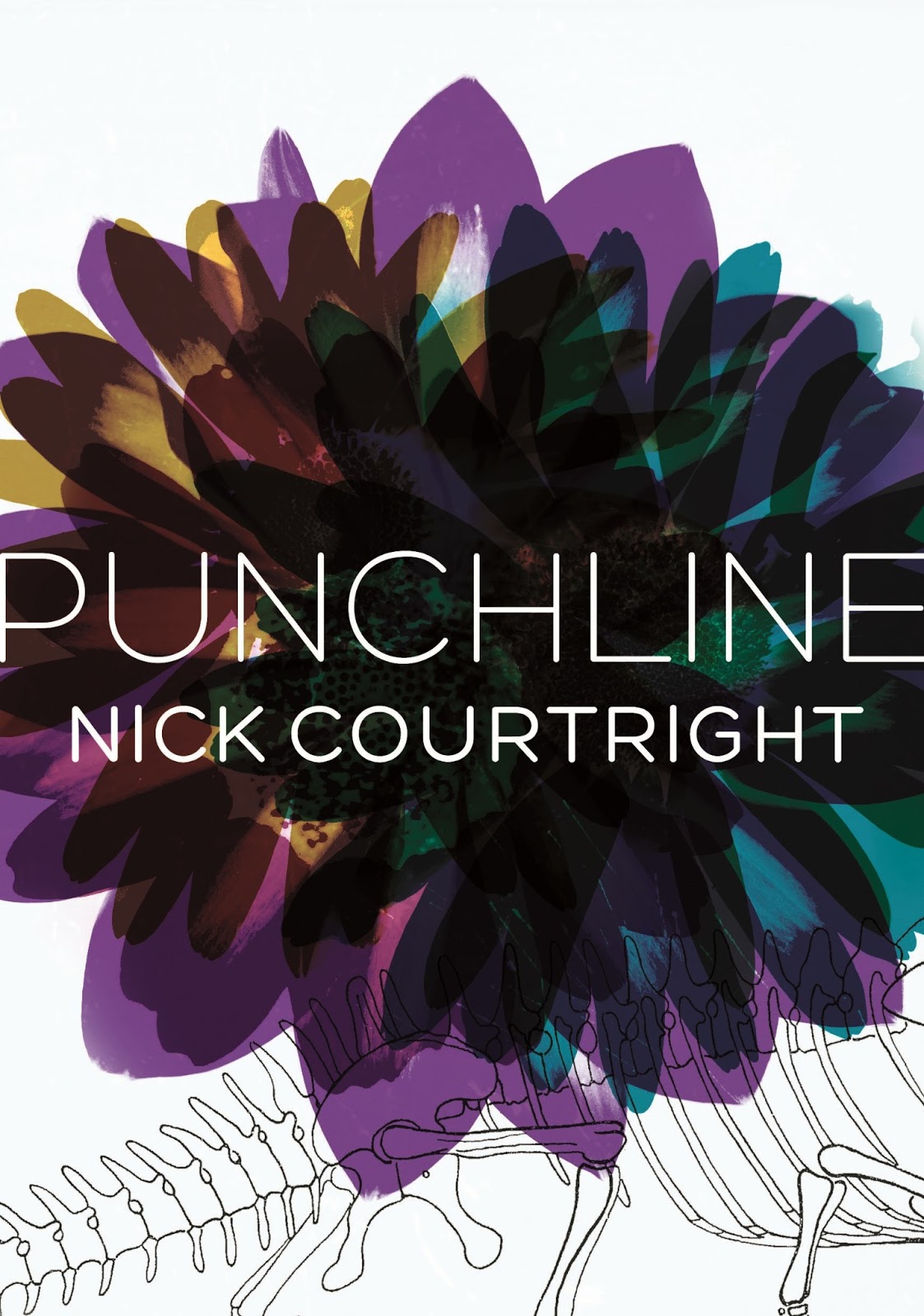
Punchline

Nick Courtright is a poet who lives and writes in Austin, TX. In addition to writing poetry, he is the interviews editor for The Austinist and teaches literature and writing courses at several universities in the area. Courtright’s first book Punchline (Gold Wake Press, 2012) explores the confluence of philosophy, art, and life in order to come to terms with “our being and seeking” (75), one poem or “organized plan at a time” (7). The poet graciously took some time via email to answer some questions regarding his work.

Near the conclusion of Punchline, readers will find the poem “Ghosts,” which ends with the line “Being: of all the poems in the world please let just one figure it out” (72). The sentiment of this line, it would appear, is the belief in a singular poem that will clarify ontological problems or issues. Do you believe that such a poem exists? I ask, I suppose, because it would seem to me that the process of writing or reading poems, or perhaps thinking poetically over the course of a lifetime, could be one essence of Being, in and of itself. What are your thoughts on this?

The way I see it, it's less a “belief” in a singular poem that will clarify problems of being, and more a plea: in short, and at first blush, Im highly skeptical that such a poem exists. That, of course, doesnt stop me from hoping that one could exist. Could that poem have been written two thousand years ago? Sure, why not. Could it have been written this week? Yep. But has it been written? I doubt it, and not because I don't think poetry is perhaps the best method for tackling ontological questions. Its more because I recognize that poetry is a human art, and I have grave doubts about human beings ability to know the answers to much of anything, let alone the severest issues of our own existence. But I know that the true skeptic must doubt his doubt, and by such measure, every poem ever written is very very much the absolute and undeniable essence and immanent embodiment of utter Being. Right? What everyone is doing right now is THE TRUTH. Because how couldnt it be?

You divided Punchline into four sections, and each section begins with an epigraph: the first by a physicist (Einstein), the second by an astronomer/entertainer (Sagan), the third by a poet (Lorca), the fourth by a mystic/religious figure (Suzuki). To this extent, you seem to be suggesting a relationship or correspondence between these people and their discourses. Could you speak to how you conceive of the relationship between science, poetry, philosophy, and religion? What are the commonalities? What are the differences?

This is a dangerous question, because answering it is a necessary spoiler for a future text. So, profoundest of plaudits to you, dear interviewer, for asking it. I see a fundamental connection between Philosophy, Science, Religion, and Poetry, and, in fact, those are the four sections of a book I am working on. The basic argument, and answer to your question, is as follows: "Humankind has employed three methods in its search for truth: Philosophy, Science, and Religion. Each of these methods employs a different tactic: Philosophy uses logic, Science uses experiment, Religion uses revelation. The word that means “philosophy + science + religion” is “poetry.” Poetry, using everything, is the art by which the search best speaks." And that little section there in quotes is actually an introduction of sorts for the book I'm working on, tentatively titled The Humors, and not the book that is coming out next year. This whole entangled, complicated thing is, obviously, an audacious claim, and I just began to tackle it in Punchline. I'm excited to push it even further in the future, because I do believe all of these methods of comprehension to be not different elements of existence and its understanding (a la Descartes), but just different manners of looking at the exact same thing (a la Spinoza). And, at its root, I believe that poetry, for better or for worse, is the best way to bring them together.

You have a book coming out next year? Congratulations! Can you talk about the relationship (both the similarities and differences) between this new collection and Punchline? Likewise, tell me a bit more about The Humors. Obviously, based on your previous answer, it engages some of the same ideas as Punchline; but how does it differ? Finally, how would you explain, in general, the aesthetic and conceptual concerns of your poetry (particularly in Punchline) to both someone unfamiliar with poetry and someone deeply entrenched in the discourse/art?

The new book is actually a lot different than Punchline, and I'm really excited for it to come out. I've yet to post about it on Facebook so I suppose that means it's not yet real. The new book is called Let There Be Light, and (and this is the first time I'm explaining it in writing) it's built around the first seven days of creation according to Genesis 1:1-2:3. Except in reverse, so Day 7 is the first part of the book, then Day 6, then Day 5 on down to the very beginning; Day 5, for example, is the day fish and birds were created, so that section, obviously, has a lot of fish and birds in it. It's not a religious book by any means, but it is a book that explores what myth can do for us in the real world. The poems are different because they are more, I suppose, traditionally lyrical and self-contained than the ones in Punchline, which tend to spill over from one to the next. I'm terribly thrilled to have this book come out, because it was a long time coming, as it was a tortured wreck for years before it found its present form. As for The Humors, I'm still working on it, but I see it as more of a sequel to Punchline; whereas Punchline was about uncertainty and tolerating what we can't know, The Humors is more about what we can do about it. It's triumphant and tragic, and wouldn't have had a chance to exist without my having survived Punchline.

And how do I explain my aesthetic and conceptual concerns of my poetry? Aesthetically, I like white space and pacing via lineation, as I'm a big advocate of a friendship between the work on the page and the work read aloud. Conceptually, I'd say I'm very influenced by the tradition of poets as wise mysticst—he Rumis and Blakes and Mirabais and Lao-Tzus of the world—and I want to try to tap into that. Not just poetry as entertainment or intellectual plaything, but poetry as guidebook and inspiration-for-epiphany. Whether I get there is highly debatable, but it's what I'm shooting for.