04 October 2016

Grace Period: 1998-2007

This article first appeared as a post titled "Best Thing I’ve Read This Week: Grace Period" at Vouched Books on 08 July 2013.
Grace

The title of Aaron Kunin’s Grace Period: Notebooks, 1998-2007 (Letter Machine Editions, 2013) provides a more or less straightforward explanation of what readers will encounter between the covers of this book: the contents of a writer’s notebooks over the course of a decade.

Early in the collection, in what can be read as a meta-critical observation of his work, Kunin writes:
My teachers were indulgent of the chaos of my thoughts. (Luckily?) Would it have been better if they had held me to a standard that I could not recognize (or value)? —Better to preserve your thoughts in their original chaos. (49)
And it would appear that Grace Period does just that: it preserves the “original chaos” of the author’s thoughts as they move from one fragment to the next, documenting the patterns of a mind at work.

Stated differently, the form of Kunin’s notebooks, and thus his mind, are “bits and pieces of useless information” which he collects: “touches of knowledge” that he isolates “from the impurities” of the “environment” surrounding them (79).

Of course the “uselessness” of these touches of knowledge that Kunin collects is relative. On the one hand, they are “Ancient emotional material for [his] poems” (260) and, therefore, quite useful; on the other hand, while “His method makes it easy to collect material for poems,” it does not make it any easier “to assemble them” (274), calling into question their efficacy.

Kunin’s meditations, though, are more than meta-critical observations. He attends to subject matter as diverse as awkwardness, food, conversation, dreams, love, community, and poetry. Yet one of the more fascinating objects of contemplation is the author’s handwriting. Throughout the book, he creates “graphological portraits” that focus on the nature of his penmanship. For instance:
He often went over letters to add feature that hadn’t come out clearly on the first pass. This tended to give the letters a worried aspect; there were lines all around them, pouring out of them, and deep creases in the places where the lines joined, as though they had been losing sleep. The halo of uncertainty around each of your letters. The mantle of shyness that your writing wears. (8)
While this portrait offers a psychological self-analysis of and via his handwriting, it also emphasizes the materiality of Grace Period and the absence of the original artifacts. Which begs the question: how do the material circumstances of one’s composition dictate what one composes? And, what do we gain and what do we lose from a printed version of his notebooks? Later, Kunin emphasizes this point when he writes:
Try to look like you’re working. Seated in odd positions, or standing and pacing. Ah, he’s writing; this looks like work. If only the notebook were in larger format. What can he be working on. Such tiny pages, etc. Nothing that could be shown easily since no one could read his little writing. (218)
Focusing on his material conditions yet again, Kunin laments the fact that the notebooks are not of a “larger format.” This constraint forces him to write in a “little” hand, which, no doubt, contributes to the fact that he composes primarily in the aforementioned “bits and pieces.”

But just as compelling as the material considerations, Kunin wants to “look like [he’s] working,” which highlights the performative nature of his writing. To this extent, Grace Period is a public display of the writer's private thoughts for the sake of intellectual and creative showmanship, wherein materiality becomes performance, and composition (or form) an actor.

Bret Shepard Reads "Skin Interims"

This article first appeared as a post titled "Best Thing I’ve Read Today: Bret Shepard’s “Skin Interims" at Vouched Books on 01 July 2013.

The new issue of The Diagram went live yesterday. As always, the editors have put together a fantastic issue. I'm especially a fan of Bret Shepard's four-part poem "Skin Interims."

A couple weeks ago, Bret and I visited a playground at a middle school in Lincoln and he read from the poem. Check out the video below, then head over to The Diagram's website to read the entire issue. You can also read more of Bret's work at Sink ReviewILK, and The Leveler:

Forty-One Jane Doe's

This article first appeared as a post titled "Best Thing I’ve Read This Week: Forty-One Jane Doe’s" t Vouched Books on 24 June 2013.

41JaneDoesCoverLast week, I wrote a review of William Waltz’s Adventures in the Lost Interiors of America, which focused on the differences between a naturalist’s and a poet’s use of nature. In the former instance, the man of science observes and categorizes the natural world in order to demystify and, thus, command it; in the latter instance, the poet revels in its mysteriousness and unquantifiable aspects in order to create an art imbued with the unknown.

Immediately after reading Waltz’s collection, I read Carrie Olivia Adams’ second full-length book of poetry Forty-One Jane Doe’s (Ahsahta Press, 2013). I reference Waltz’s Interiors not simply because it was the book I read immediately preceding Adams’ collection, but primarily due to the fact that the two books contain thematic echoes. Whereas Waltz juxtaposes the poet and the naturalist, Adams explores the relationships between the poet and mathematicians/scientists.

Skimming through the epigraphs and notes reveals several scientific touchstones that Forty-One invokes: Leonard Euler, William Harvey, Stephen Hawking, and Pythagoras. But, similar to Waltz’s book, Adams does not attempt to mimic the scientist's drive toward enlightenment through empiricism. Instead, she uses poetry as an antidote for science in order to articulate her confusion and revel, linguistically, in the unknown. Take, for instance, the following passage from her opening sequence “A Mystery Story”:
Moments after asking
what is the meaning of love
she makes love.

This does not answer
the question. (8)
The speaker runs what one could call an experiment on love in order to discover its “meaning.” Of course, once she conducts the experiment (i.e. “makes love”), she realizes that “This does not answer / the question.” No, love is not something that one can capture or define through a series of tests. It is something too ethereal for such operations.

In the second poetic sequence, an epistolary prose poem titled “Pandora’s Star Box,” which is addressed to an “Astronomer,” the speaker asks:
What do you do during the daylight? Do you train your telescope on people across the way? Are you curious at all about earthly perambulations? Do you chart them—map them—trace them from point to point with a protractor in the same way?

I once wrote to you and asked—why do people make love? It was a foolish question, I know. (18)
The Astronomer stands at a distance from the populace, charting and mapping their “earthly perambulations” with a telescope and a protractor. In need of an answer to the question “why do people make love,” the speaker realizes that “It was a foolish question” to ask her correspondent because love cannot be gauged by or through the instruments of science. Again, love is something too ineffable for empiricism to categorize or gauge.

The final poem of Forty-One, which is called “A Voice Made Small,” begins with the stanzas:
My voice made small
travels with others
along the copper wires.

Then, there is the sea—
I do not know how sound travels
across it.

The tips of the waves,
moths that flutter toward your ears. (73)
There is something inherently mysterious or otherworldly about a voice crossing the ocean. No doubt, science can find a way to demystify this question regarding “how sound travels / across it”; and, in many instances, such exacting scientific knowledge is of importance to us as human beings. But, in other instances, the poetic explanation, that of a voice travelling on the “tips of the waves,” or as “moths that flutter towards your ears,” offers readers something much more poignant and, certainly, more beautiful.

The poem, then, concludes with the following stanza:
If you know the end,
if the day has already come
and another begun for you
can you tell me of it,
so I may know
what to look for? (74)
In these six lines, the speaker vocalizes her desire to know that which is out of her intellectual grasp. But, after reading through Forty-One Jane Doe’s, we get the sense that, even if the addressee does have the ability to answer the question of “what to look for,” it will leave the speaker lacking or wanting more. Instead, a better answer maybe no answer at all; simply to acknowledge that:
There is a sea—
It could carry us.
It could lose us. (73)
And, yes, this sea is poetry.

Interview with James Belflower

This articles originally appeared as a post titled "Awful Interview: James Belflower" at Vouched Books on 24 June 2013.

postureFINAL-COVER-web-750x380
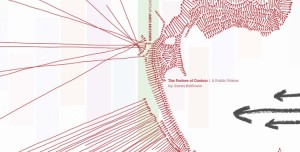
Springgun Press released three new collections in February of this year, two of which I reviewed a couple of weeks ago. The third offering they released was James Belflower's The Posture of Contour: A Public Primer, which is by turns poetry, philosophy, and performance art. Over the past several weeks James has been on a reading tour, during which time he and I corresponded about his new  book.

Your new collection, The Posture of Contour: A Public Primer (Springgun Press, 2013), reads like a work of pataphysics, which Jarry defined as “the science of imaginary solutions.” Would you agree with this claim, why or why not? How would you describe your book to someone who has not yet read it? What other texts influence or inspired you to create a work in this form? (I realize the Works Cited section lists many texts; but I'm more interested in the form and/or genre of the text, as opposed, strictly speaking, to the content.)

I think pataphysics is an excellent framework for the book, though I’m wary of getting hung up if the term is too firmly hung on to. Alfred Jarry’s extended definition is helpful for avoiding this since it expands on a couple of the more ambivalent motifs of the text. He describes it as a science which “symbolically attributes the properties of objects, described by their virtuality, to their lineaments, [...] it is a science which lies as far beyond metaphysics as metaphysics lies beyond physics, in any direction.” I’m using virtuality a bit differently, but Jarry’s emphasis on description through virtuality to an object’s “lineaments” encourages all types of thinking conducive to investigating postures, gestures, contours, and non-coordinate dimensions.

The effectiveness of pataphysics as a poetic methodology isn’t new, but has remained on the literary periphery in the U.S. For me it’s inextricable from the humor of the epigraph by Andreas Cappellanus that begins the book, and Cage’s cognitive dissonance in “Lecture on Nothing.” I came to it roundaboutly by way of Gilles Deleuze, who is part of a larger coterie promoting this pseudoscience, which includes many of the Oulipo, Marcel Duchamp, Antonin Artaud, and most recently Christian Bök. Its effectiveness really hit home as I approached the fluid dynamic equations that often serve as titles throughout the book. Fluid dynamics is not a traditional discourse for poetry, so part of my reasoning for incorporating equations is that it forced me to approach my ignorance of the topic in very different ways. In other words, I thought of imaginary solutions. I knew that “solution” in the sense of solving these formulas was not an option, so the exercise necessitated returning through ignorance which demanded a repeatedly novel schematic. Rather than a science of imaginary solutions, for me it became a science of imaginary approaches to very real problems. Without the knowledge to solve them, these approaches were sustained through inventive address, rather than mastery or control.

It’s vital (Jarry even called it a “crying need”) that we reinvigorate a science of imaginative solutions because, at the very least, the process of importing solutions from one sense making mode to another generates very real and very fecund conceptual struggles. These are particularly catalytic in the other meaning of solutions: chemical baths, or logic systems (Albert Ayler might have named them smears, Gilbert Simondon uses them to describe individuation) into which alternative mixtures and discourses are introduced to produce very different links across all dimensions of connectibility. In my wildest hopes, The Posture of Contour serves as a primer for approaching some of these dimensions.

Throughout Posture, you've embedded sidebars that provide the reader/performer of the text with physical and tonal flourishes that enhance the written word when performed for an audience. Could you speak about the relationship you've attempted to foster between the abstract and the corporeal self and/or kinetics? What is the relationship between the two, to your mind? What can we learn from the tensions or relationships between them?

The figure began as the “Performer” in my first book Commuter (Instance Press, 2009), but didn’t appear as the Virtuoso until Posture of Contour. In one sense, the figure of the Virtuoso tunes into Jack Spicer’s call for poets to be entertainers. In another sense, the figure is derived from Paolo Virno’s analysis of linguistic economy in the Post-Fordist public sphere, where he describes the contemporary speaker’s flexibility and adaptability as virtuosic, practicing an activity that “produces something which is not distinguishable nor even separable from the act of production itself” and is understood as “an activity which requires the presence of others” (52).  Surprisingly, he pinpoints the most politically salient features of virtuosity as idle talk and curiosity, noting in disagreement with Heidegger’s insistence on a purely mental ecology, that idle talk carries great potential for imaginary invention and experimentation, but is also foundational to social production. Though Heidegger also dismissed curiosity as a contaminated form of knowing, Virno, drawing from Walter Benjamin, finds in it a socially engaged and enriching practice rooted in the commonly sensual.

For me, the Virtuoso is a figure that embodies an enactment of the circulation between ecologies; Buñuel’s sliced eye is a perfect example of mingling the “fluid of a mental ecology” with that of an exterior one: the moon, magically evoking the gut wrench of disgust. Of course, rooting it in violence imports all sorts of other problems I grapple with in the razor sections, but regardless, the Virtuoso enacts this through idle talk and curiosity. The Virtuoso is the most active event that encourages an emerging counterpublic: it is the reader, myself, an object on the wall, an eye, a razor, a gesture, a sound, etc. I like the way Michael Warner puts it, “Counterpublics are ‘counter’ to the extent that they try to supply different ways of imagining stranger sociability and its reflexivity; as publics they remain oriented to stranger circulation in a way that is not just strategic but constitutive of membership and its affects” (122). As one of the figures circulating through these occurrences, the Virtuoso relies on the attraction of curiosity, gestures, confusions, noises, idle talk, and conversations real and imaginary, but all given more to poesis than persuasion. In the process of emerging, the Virtuoso creates a politics of wonder: believes the plastic static of a trash bag might attract anyone’s tongue, and that a grandiose flick of the hand toward any object on the wall also draws that object into a social gambit.

As I’m sure you noticed, most of the activities of the Virtuoso in Posture are limited to gestures or flourishes that don’t require any specialized training outside of basic literacy. I wanted to avoid the more common understanding of Virtuoso, and perhaps transform some of the more exclusionary qualities of performance into invitational alienations. I have misgivings about the term “performance art” (as probably most people do!), but I knew that I wanted to stimulate a “public” by rethinking the reader as a real and imaginary performer through the Virtuosic sidebars. What excites me is the possibility that other virtuosos might publicly perform Posture! This is one of the main reasons for including aural collaborations with the book on Soundcloud, to encourage a public of a different sort.

In Posture, you write that “what if we attempt to enfold mathematical formulas not for the purpose [of] comprehension but for purposes [of] resistance” (54). If “comprehension” and “resistance” are placed in binary relation to one another (and we, thus, can read “resistance” as something akin to obfuscation), does resistance/obfuscation serve as a viable “solution” to a problem? And if resistance/obfuscation is a viable solution, does that negate pragmatics (which Deleuze and Guatarri, particularly, were champions of) and use-value? Are pragmatics and use-value modes of operation or intellectual stances you find compelling or worthwhile? If so, how do you remedy the apparent contradiction; if not, what purpose does your text serve?

The excellent question you raise regarding a binary between comprehension and resistance is an ongoing one for me. I think resistance and comprehension are not necessarily binary. For one thing, resistance can take many forms, but for some reason obfuscation, unintelligibly etc., seem to be the popular ones. I think that’s why I gravitate toward Deleuze because he models a philosophy that wants to (though it’s up for debate how successful he is) reconsider the binary thinking that opposes those two terms.

I always return to his section on the Body Without Organs in 1000 Plateaus for trying to understand the complexity of that comprehension/obfuscation binary. His emphasis on intimacy with the resisted object, or idea, his emphasis on motion, and on provisionality and contingency is of utmost importance for Posture:
Lodge yourself on a stratum, experiment with the opportunities it offers, find an advantageous place on it., find potential movements of deterritorialization, possible lines of flight, experience them, produce flow conjunctions here and there, try out continuums of intensities segment by segment, have a small plot of new land at all times. It is through a meticulous relation with the strata that one succeeds in bringing forth continuous intensities for a BwO. Connect , conjugate, continue: a whole 'diagram' as opposed to a still signifying and subjective program (161)
His advice here has always struck me as very pragmatic: know the thing, concept, idea, etc., your attempting to subvert, or at least get very close to it!

So the long answer to your question culminates in saying that, yes, I definitely subscribe to a pragmatics and a use-value, but both couched in all the speculation and provisionality one can muster. I think this approach amplifies potential of all sorts: it provides options, and makes them manifest. The “Approaches” to fluid dynamics are an example; rather than obfuscating them, my readings offer other potential methods for engaging them. It recognizes other approaches through which they might potentially sense, and this sense, while not contributing to the primary logic from which they are derived, allows a public to communally engage them and diagram a variety of implications.

I think it was Deleuze who said that current philosophy is not abstract enough. I wonder what happens if we consider contemporary poetry as having a similar issue? If we collectively recognize the virtual quality to life, and tailor our language for that approach, then it has a greater opportunity to emerge. There seem to be many ways of pointing toward virtual things before obscuring others is necessary. Okay, off my soapbox, it's sounding very utopic from up here!

Adventures in the Lost Interiors of America

This article originally appeared as a post titled "Best Thing I’ve Read This Month: Adventures in the Lost Interiors of America" at Vouched Books on 20 June 2013.

WWCover2
William Waltz’s Adventures in the Lost Interiors of America (Cleveland State Poetry Center, 2013) opens with an epigraph excerpted from a letter that Alexander von Humboldt, a Prussian geographer and naturalist, wrote to a friend in 1799. It reads:
I shall collect plants and fossils and make astronomic observations. But that’s not the main purpose of my exploration—I shall try to find out how the forces of nature interact upon one another…In other words, I must find out about the unity of nature.
Framing his collection as such, Waltz leads readers to believe that his second full-length collection of poetry, which won last year’s Open Book Competition for CSU’s Poetry Center, will focus on the natural world in order to discover or make sense of the “unity of nature” and how different natural elements “interact” with one another. In words, the collection will tell us something both of the natural world surrounding us and our relationship to it.

But, in the prefatory poem “Before We Begin,” Waltz appears to undercut this project when he writes:
Let us praise the unknown
source lurking below, let’s
appreciate how little we know,
how little what we know
matters (3)
How does championing “the unknown,” acknowledging our own ignorance, and discrediting the knowledge we do possess enable us to learn anything? Moreover, if what we do discover proves fruitless, what is the point of acquiring it in the first place?

This, of course, is a bit of a rhetorical dodge by the poet. In all actuality, Lost Interiors seeks out the inexplicable and the unknown in order to praise the mysteries of the world as an end, not as a means of acquiring knowledge or empirical enlightenment. Take, for instance, the concluding lines of the poem “Natural Science.” The poem’s speaker stands upon the shore of Green Lake, looks outward, and notes:
Although I couldn’t see
beyond the dark spot bobbing
in the morning mist,
I knew the sun shone somewhere
and the far shore brandished
a stand of shining white birch.
There was nothing left
to do but dive in
before the smell of black
coffee and blueberry pie
reminded me how beautiful
and incomplete
my communion was
and would be until
it was no longer. (10)
The speaker can’t see the sun or white birch while morning mist obscures them both. But he worries not. Instead, he dives into the lake and remembers “how beautiful / and incomplete” our “communion” with the natural world happens to be. Indeed, the “incomplete” is not understood as lack or as failure of comprehension; rather, the speaker understands the “incomplete” to be a beatific engagement with nature.

Waltz forwards a similar argument in the prose poem “Letter to an Incomplete Stranger,” in which he writes:
I feel certain we can again, coexist, I mean. You may not remember, but our eyes meet once in a cool, wide pool of plate glass. I knew then I would never understand you completely, nor would I betray you by thinking I did. (14)
The speaker of the poem and the addressee will “never understand” one another “completely,” nor will they pretend that they do. But the two of them can “coexist” in this incomplete understanding. Moreover, acknowledging the incompleteness of their relationship leads to an honesty wherein they will not “betray” the unknown that divides them like the “cool, wide pool of plate glass.” Yes, they can see one another; but, no, they will never comprehend.

To this extent, then, Waltz’s book asks us to cast aside our desire for empirical pursuits championed by men of science and revel in the poetic possibilities of the incomplete and the unknown. Adventures in the Lost Interiors of America would rather have us traverse the linguistic landscapes and waterways of Cape Cod, Resurrection Bay, Pike Island, Lake Superior, Medicine Rock, Serpent Mound, Big Sur, Kilauea, the Everglades, the Mississippi River, Oregon, Idaho, Montana, and Ohio, losing ourselves in their expanse. In doing so, we let them enter us, as in the prose poem “Birds, Still”:
The woods walked through us and left a trail. We followed, down a street, over a hill, across a stream and a field, and then through a wood where we came upon a thicket rich with cricketsong and morning thorn. We peeled back the pricks and moved like herons through the reeds until an opening and then the prairie and across we saw a flock of silhouettes in a colossal crown. We climbed the wild tree and never came down. (25)
Yes, let the natural world walk through us so we can follow it, watch it, listen to it, and never come down from its wild trees.