
This article first appeared as a post titled "Awful Interview: Rebecca Hazelton" at Vouched Books on 18 July 2013.
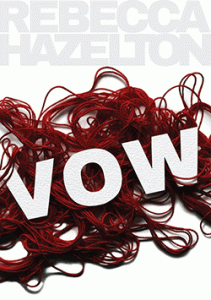 Rebecca Hazelton's first book, Fair Copy, won the 2011 Ohio State University Press Poetry Prize. Her second book, Vow, was a runner-up for the 2012 Cleveland State Poetry Center's Open Book Competition and was published earlier this year. In Vow, Hazelton's poems call "the world into notice" (1) through language, while simultaneously expressing anxiety of language's failure to do so, at least to the extent that speaker of the "Book of Memory" concedes: "I have no words for the one in the mirror / who apes me every morning" (1).
But the tension produced between the creation of worlds via words and the abject failure of words is not the thematic limit of Vow; in fact, there are many tensions that proliferate throughout this collection. Hazelton was kind enough to take some time during the past couple of weeks to discuss some of the other issues at hand in her second book.
In the title poem of your second full-length collection Vow, the speaker begins by referencing a couple that “were not traditionalists” (20); by the end of the poem, though, they “stood up and received the standard narration” (21). These excerpts speak, I think, to a tension that runs throughout the collection. Was the struggle between tradition and innovation, whether thematically or poetically, something you considered when writing the poems that became Vow? If so, could you talk a bit about how you worked through those ideas? If not, do you think about your collection this way in hindsight; or are there other, more pressing concerns for you in this book; if so, what?
I didn’t consciously set out to investigate tradition versus innovation, but now that you mention it I certainly see ways in which that operates. My first book, Fair Copy, was entirely in a very old form, the acrostic, and so writing in free verse for Vow felt quite liberating. Of course, it’s arguably more radical these days to write a book in form, so questions of tradition are complicated when an innovation becomes the norm, as free verse certainly is these days.
But I might rather say that both the poem and the book are concerned with constraint versus freedom, which plays out in a number of ways. As suggested by the book’s title, and this poem in particular, the vows of marriage are constraints equally attractive and vexing. Our expectations for our lives are constraints, even if those expectations are for freedom and wildness. Youth always wants to break the mold, but eventually, youth grows up and becomes like everyone else, and that disparity between what we thought our life would be and what it becomes is either tragic or a testament to our shared experience as humans. Not to mention the constraints we can’t even see, but operate on us all the same—our social and economic backgrounds, our biological makeup, our time period and location. I see a tug of war between constraint and freedom—or what looks like freedom—throughout the book, and it’s typified through various roles—predator and prey, femme fatale or ingénue, faithful or faithless.
Vow contains several unique series of poems (such as the Rabbit and the Fox sequence, the Elise sequence, and the Book Of sequence). Could you tell me a bit about each of these groupings and, at least to your mind, what’s the driving force behind each one? Also, when putting together the manuscript, how did you see these three sets of poems interacting with one another? How did it affect the collection’s sequencing and order?
Whenever I introduce a poem from the Fox and Rabbit series at a reading, I always preface the poems by explaining that they are about two characters in a relationship, and as you might imagine from their names, it’s a problematic one. By having my characters named after (and in some cases, acting like) animals, I was able to talk about the idea of predators and prey, both in the natural world and in relationships, where it’s a far more freighted and complicated idea. The poems are persona poems, almost entirely from Fox’s point of view because I feel like we are naturally inclined to romanticize a prey animal, and to villainize a predator.
In the Elise poems, I suppose I wanted to try and do what many elegiac poems strive for—to bring a person back to life. In the case of these poems, it’s a person my speaker had a very fraught relationship with. The Elise I try to capture in these poems is like many larger than life women—magnetic, infuriating, beautiful, and awful.
The “Book of ____” sequences are rather different. They aren’t persona poems like the first two. I was initially inspired by a scene from Peter Greenaway’s movie “The Pillow Book”—where the heroine creates her final “books” by writing on others’ bodies. I love the idea of a body as a book, that our experiences write on us, mark us. In writing these poems, I started with the title—Book of Longing, Book of Letting Go—and essentially meditated on the subject. The poems are more associative and far less narrative than the other two series. They go strange places.
In putting together the manuscript, I tried to braid them throughout the text, so that the reader would come back to one story, another, as he or she read. There are images that are shared among all three, and I think they speak to each other thematically as well. Fox and Rabbit experience many of the emotions and experiences in the Book of ____ poems, and Elise is a figure who both inspires and complicates fidelity, another concern of the book.
To you mind, how has your writing (whether formally or thematically) altered since you composed Vow? How so? To this extent, could you tell me a bit about what you're working on nowadays and how it relates (or does not relate) to your previous two collections?
I’m probably not the best person to answer this first question—I am very myopic as to my own work. But I’ll do my best, and say that I’m working far less with persona than I was in Vow—the work is a bit cooler, less hotheaded, not dispassionate by any means but a bit more distant. For me, Vow was very much trying to articulate conflicted passions, and my recent work is more concerned with reflection, a bit more cerebral.
I’m working on a number of things—the most cohesive of which is a three part series of ekphrastic poems based on the works of painter Julie Heffernnan, photographer and conceptual artist Cindy Sherman, and performance artist Terri Frame. All three of these women use the self-portrait to comment on social, historical, and archetypal representations of women, and in that way, the work very much relates to my previous poems. I’ve always been interested in the divide between a woman’s experience and cultural representations of a woman’s experience, and how the latter can shape the former, so a self-portrait has that kind of reflexivity built-in.
 Rebecca Hazelton's first book, Fair Copy, won the 2011 Ohio State University Press Poetry Prize. Her second book, Vow, was a runner-up for the 2012 Cleveland State Poetry Center's Open Book Competition and was published earlier this year. In Vow, Hazelton's poems call "the world into notice" (1) through language, while simultaneously expressing anxiety of language's failure to do so, at least to the extent that speaker of the "Book of Memory" concedes: "I have no words for the one in the mirror / who apes me every morning" (1).
But the tension produced between the creation of worlds via words and the abject failure of words is not the thematic limit of Vow; in fact, there are many tensions that proliferate throughout this collection. Hazelton was kind enough to take some time during the past couple of weeks to discuss some of the other issues at hand in her second book.
In the title poem of your second full-length collection Vow, the speaker begins by referencing a couple that “were not traditionalists” (20); by the end of the poem, though, they “stood up and received the standard narration” (21). These excerpts speak, I think, to a tension that runs throughout the collection. Was the struggle between tradition and innovation, whether thematically or poetically, something you considered when writing the poems that became Vow? If so, could you talk a bit about how you worked through those ideas? If not, do you think about your collection this way in hindsight; or are there other, more pressing concerns for you in this book; if so, what?
I didn’t consciously set out to investigate tradition versus innovation, but now that you mention it I certainly see ways in which that operates. My first book, Fair Copy, was entirely in a very old form, the acrostic, and so writing in free verse for Vow felt quite liberating. Of course, it’s arguably more radical these days to write a book in form, so questions of tradition are complicated when an innovation becomes the norm, as free verse certainly is these days.
But I might rather say that both the poem and the book are concerned with constraint versus freedom, which plays out in a number of ways. As suggested by the book’s title, and this poem in particular, the vows of marriage are constraints equally attractive and vexing. Our expectations for our lives are constraints, even if those expectations are for freedom and wildness. Youth always wants to break the mold, but eventually, youth grows up and becomes like everyone else, and that disparity between what we thought our life would be and what it becomes is either tragic or a testament to our shared experience as humans. Not to mention the constraints we can’t even see, but operate on us all the same—our social and economic backgrounds, our biological makeup, our time period and location. I see a tug of war between constraint and freedom—or what looks like freedom—throughout the book, and it’s typified through various roles—predator and prey, femme fatale or ingénue, faithful or faithless.
Vow contains several unique series of poems (such as the Rabbit and the Fox sequence, the Elise sequence, and the Book Of sequence). Could you tell me a bit about each of these groupings and, at least to your mind, what’s the driving force behind each one? Also, when putting together the manuscript, how did you see these three sets of poems interacting with one another? How did it affect the collection’s sequencing and order?
Whenever I introduce a poem from the Fox and Rabbit series at a reading, I always preface the poems by explaining that they are about two characters in a relationship, and as you might imagine from their names, it’s a problematic one. By having my characters named after (and in some cases, acting like) animals, I was able to talk about the idea of predators and prey, both in the natural world and in relationships, where it’s a far more freighted and complicated idea. The poems are persona poems, almost entirely from Fox’s point of view because I feel like we are naturally inclined to romanticize a prey animal, and to villainize a predator.
In the Elise poems, I suppose I wanted to try and do what many elegiac poems strive for—to bring a person back to life. In the case of these poems, it’s a person my speaker had a very fraught relationship with. The Elise I try to capture in these poems is like many larger than life women—magnetic, infuriating, beautiful, and awful.
The “Book of ____” sequences are rather different. They aren’t persona poems like the first two. I was initially inspired by a scene from Peter Greenaway’s movie “The Pillow Book”—where the heroine creates her final “books” by writing on others’ bodies. I love the idea of a body as a book, that our experiences write on us, mark us. In writing these poems, I started with the title—Book of Longing, Book of Letting Go—and essentially meditated on the subject. The poems are more associative and far less narrative than the other two series. They go strange places.
In putting together the manuscript, I tried to braid them throughout the text, so that the reader would come back to one story, another, as he or she read. There are images that are shared among all three, and I think they speak to each other thematically as well. Fox and Rabbit experience many of the emotions and experiences in the Book of ____ poems, and Elise is a figure who both inspires and complicates fidelity, another concern of the book.
To you mind, how has your writing (whether formally or thematically) altered since you composed Vow? How so? To this extent, could you tell me a bit about what you're working on nowadays and how it relates (or does not relate) to your previous two collections?
I’m probably not the best person to answer this first question—I am very myopic as to my own work. But I’ll do my best, and say that I’m working far less with persona than I was in Vow—the work is a bit cooler, less hotheaded, not dispassionate by any means but a bit more distant. For me, Vow was very much trying to articulate conflicted passions, and my recent work is more concerned with reflection, a bit more cerebral.
I’m working on a number of things—the most cohesive of which is a three part series of ekphrastic poems based on the works of painter Julie Heffernnan, photographer and conceptual artist Cindy Sherman, and performance artist Terri Frame. All three of these women use the self-portrait to comment on social, historical, and archetypal representations of women, and in that way, the work very much relates to my previous poems. I’ve always been interested in the divide between a woman’s experience and cultural representations of a woman’s experience, and how the latter can shape the former, so a self-portrait has that kind of reflexivity built-in.

