06 October 2016

48 Pornos

This article first appeared as a pots titled "Best Thing I’ve Read Today: 48 Pornos" at Vouched Books on 13 August 2013.

tylergobble_48pornoscover-01Urbandictionary.com provides several definitions of a circle jerk. The most common (and literal) definition is when "a group of males sit in a circle, jerking each other off." There is, though, and alternate definition, which is the "practice of expressing emotions, feelings, and...sentiments as a means of bonding or gaining appreciation for the members of your team.”

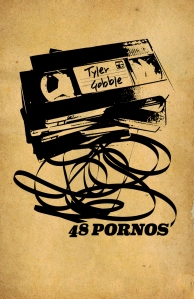
Both definitions of circle jerk are apropos in the case of this review of Tyler Gobble’s 48 Pornos (Safety Third Enterprises, 2013). On the one hand, Gobble’s chapbook contains brief prose blocks that describe the scripts for a series of imaginary pornos; on the other hand, Gobble also contributes to Vouched Books. Regardless of what definition of circle jerk you choose to use, a masturbatory specter most definitely haunts this review.

As mentioned, these prose poems present an outline for forty-eight different pornos, each one opening with the phrase “Get this”; take, for example, the following:
Get this: A man at the bar wins the contest for eating the most cockroaches. His prize: He gets to fuck The Cockroach Queen. She is draped across the table on which he won. And below her, he is dying. He apparently is allergic to shellfish. Those last two parts are not in the script. (3)
or:

Get this: A woman opens her legs and out stumbles two overfed roosters. A man in flannel beheads the roosters. The man invites the woman over for dinner. After dinner, they fuck, but it’s a really short scene. (7)
The chapbook proceeds in this fashion, offering readers vignette after vignette of increasingly bizarre scripts. While some of the poems read like they actually could be pornos, the most unbelievable and preposterous scripts tend to be the most interesting.

In this sense, the collection seems to be less intent on titillating or the constructing an erotic tableaux, and more interested in creating an absurd landscape populated with surreal images wherein people happen to be engaged in various sexcapades. To this extent, the poems in 48 Pornos can act as a catalyst for a more in-depth critique (or at least they broach questions about) the proliferation of niche and fetish cultures in our digital, Internet-based age.

Furthermore, the collection also seems to suggest an overlap between the pornography and celebrity industries. With actors that “look like” (10) pop culture icons such as Jeff Gordon, Bon Jovi, Jesus, Garth Brooks, and LL Cool J, it’s difficult not to read these poems as a commentary on the manner in which we fetishize images of cultural icons and entertainers. Which begs the question: are magazines such as US Weekly and websites like TMZ pornography in their own right?

If you’re interested in issues such as these, or just want to read poems about clouds and/or dudes in g-strings fucking each other, order a copy of 48 Pornos today.

Scape

This article first appeared as a post titled "Best Thing I’ve Read This Week: Scape" at Vouched Books on 07 August 2013.

Scape_Banner

The opening stanzas of Louis Zukofsky’s “A-22” read:
Other letters a sum owed
ages account years each year
out of old field, permute
blow blue up against yellow
—scape welcome young birds—initial

transmutes itself, swim near and
read a weed’s reward—grain
an omen a good omen
the chill mists greet woods
ice, flowers—their soul’s return (508)
Written in counted verse (each stanza contains five lines, each line five words), Zukofsky winds his way through the natural world’s fields, birds, weeds, woods, and flowers in an alliterative, idiomatically dense, syntactically circuitous, but formally rigid structure. As line after line and stanza after stanza unfold, each word “carves a breath” (509) into form, shaping the poem into a linguistic landscape via its musical and grammatical elements. Certainly, “A-22” pushes toward the upper limit of Zukofsky’s poetics, an “integral” he defines as “Lower limit speech / Upper limit music” (138), in order to engage the natural world in a visceral manner that “speech” by itself cannot achieve.

It’s no wonder, then, that Joshua Harmon prefaces his book Scape (Black Ocean, 2009) with a fragment from the opening stanza of “A-22”: “—scape welcome young birds—.” Just as did Zukofsky, Harmon creates a landscape in a similar fashion, focusing on alliteration, complex syntax, and a lush idiom. Likewise, Harmon composes Scape’s first poem “Wither” in counted verse (each stanza contains two lines, each line four words). The first seven stanzas read:
—heelprint and halter, halfway
heard: before mean back

then, to know before
it breaks it lurches

so in the snowfield’s
stalk- and stem-broken

edges a rosehip bends,
reddens at its tip:

halfway across, near dusk,
to know snow before

this is nothing to
naming this unread surface

defect of drifting lines:
snow breaks back (3)
Phoneme after phoneme echo each other through alliteration and rhyme for another ten couplets, all within the framework of a single syntactical unit. The experience is not unlike walking through an expansive “snowfield” at “dusk” while "drift lines” dust over one’s path to shelter, the journey home made difficult by the unforgiving conditions. Yes, it’s easy to wander off and get lost within the landscape of the poem.

And this, I believe, is the joy of Harmon’s Scape: we can walk “step by step” through and “toward the form of a field” (7) within the poem, wherein “sound alone” (9) causes us to experience a particular type of “vertigo” (8). Indeed, our senses disorient as we travel through a poetic “landscape” that appears as “an open system, a naïve word’s wound, a trick made of…waiting breath” (13), while we journey to “the elided spaces / inside [our] head” (20).

To further highlight this point, I’ve excerpted the opening and closing lines of the poem “Escape”:
Torque of tongue
twiddle: starched
shortcomings
and-going:
when you run
the wind follows
you, falls blistered
and burnt: hand-
writing allows
such green timber
to ruin knife-knit
openings: (55)


beyond a briarneck, lapse
turns light: turl and sumac-twist
how this stretch bees

rooted redundancies
race to pattern it

These scabbed leaves loosely north,
landslipped: otherwhorled in vacancies
of bough-bladed stripling—

Lonesome intention, riven match:
boon of brazen dismantlings takes
amid later light: underwinged (56)
As with the previous excerpt, the “rooted redundancies” of alliteration build a sonic “pattern” and “torque” the “tongue” so as to cause the mouth to “sumac-twist” within Harmon’s landscapes. But, in addition to this sonic strategy, the poet creates linguistic “dismantlings” through creative slippages. To this end, “landscape” becomes “landslipped” (my italics) and “otherworld” becomes “otherwhorled.” These playful techniques allow us to whirl in Harmon’s whorled otherworld of words.

Yes, just as Zukofsky wrote “A-22” in a manner that “uncompassed” the directions “north south west [and] east” (513) in linguistic dislocation, so too does Harmon immerse us in a “landscape [that] can no longer / hold itself to together” (42), at least to the extent that its musical and syntactical structures unravel our senses and dizzy us into an ever expanding soundscape.

The Inside of an Apple

This article first appeared as a post titled "Best Thing I’ve Read This Month: The Inside of an Apple" at Vouched Books on 02 August 2013.

AppleWhether fair or not, it’s difficult for me not to think of Jorge Carrera Andrade’s Micrograms (Wave Books, 2011) when reading Joshua Beckman’s The Inside of an Apple (Wave Books, 2013). To begin with, Beckman helped translate Andrade’s poems; moreover, both collections contain short form poetry that focuses primarily on the natural world.

Andrade’s manifesto “Origin and Future of the Microgram” defines the microgram form as a:
Spanish epigram deprived of its subjective hue…an essentially graphical, pictorial epigram. Through its discovery of the deep reality of the object (its secret attitude) it arrives at a refined emotional style. An epigram, then, reduced in volume, enriched by complex modernity, widened to everything that makes up the vital chorus of the earth. (3-4)
In addition to describing the general parameters of the microgram, Andrade traces its lineage through the Japanese haiku, outlining their shared trajectory through Latin America poetry. The formal and sonic resonances between the microgram and the haiku can be seen and heard rather clearly when reading the poems. Take, for example, the poem “Poplar”:
The poplar dips it brush
into the sky’s sweetness
and makes a landscape of honey. (48)
The poem likens the poplar tree to a painter, its branch to a brush, honey to paint, and the sky to a canvas. The poem offers us a vision of the natural world wherein a tree becomes an artist, and its creation becomes one element of the natural world transformed into an aesthetic contrivance. Andrade manages to build all these transformations into a three line poem with a concise and economical style.

As with Micrograms, much of Beckman’s new book centers on short, image-based poems describing the natural world. For a matter of comparison, read [Stars], the first poem in Beckman’s The Inside of an Apple:
     Stars
that form from bells
      planes that act
like stars
        drunk blue
palette of early
night

              in which

an electric
light swings
over the yard
   it is a branch (1)
While slightly longer than Andrade’s “Poplar,” the poem still maintains a compact form with its twelve lines never exceeding four words. And just as “Poplar” transforms a tree into a painter, Beckman’s turns stars into bells; but, conversely, he also turns planes and electric light into stars and tree branches. Yes, Beckman’s poem exhibits a “drunk” poetic wherein a boozy brush paints a “blue / palette of early / night” in such a way that it confuses the natural and synthetic worlds.

While at first blush, confusing the man-made and natural worlds may appear disharmonious with the microgram’s tradition, it is, in fact, the very trajectory Andrade predicted for the form. Toward the end of his manifesto, Andrade asks: “Can one indicate the future itinerary of the microgram?” The answer, of course, is yes; and the poet offers us his prediction:
The earth’s skin has gradually begun to thicken with the works of men: tunnels, train tracks, buildings of all sorts. The metallic tower of the wireless telegraph is the tree of the modern eclogue. The waves and messages that cross intermittently in the sky have begun to replace birds. The “insignificant heroes”—as someone called the beings in my micrograms—will surely be defeated by the mechanical world…But this does not signal the death of the microgram. It will be reborn, rather, adorned with an urban character. The hero will no longer be the oyster or the swallow, but any of those mechanical creations that are transforming our time…And the microgram, that tiny lyrical composition whose name only I have invented, will bloom again, more vital and suggestive than ever. (25-26)
Returning to the transformations that occur in Beckman’s [Stars], then, we see not an aberration or bastardization of the microgram, but its natural progression and growth. In fact, the opening stanza of Beckman’s poem [That being alive] addresses this point most overtly:
That being alive
  the bees buzz around
not fields in which their lovely flowers grow
but a big plaster apartment
kinda honey and yellow (14)
The bucolic fantasies of poetry from ages past have passed. No longer do bees swarm fields, pollenating the flowers growing there; rather, they “buzz around” a “big plaster apartment.” Indeed, the landscape of our “mechanical world” has altered dramatically, and the poet must account for these alterations if the microgram and its newer permutations intend to “bloom” in our contemporary times.

There is, yet, another difference between Beckman’s The Inside of an Apple and Andrade’s Micrograms that bears mention. According to the Ecuadorian poet, a microgram should be “deprived of its subjective hue” and offer readers an objective account of the natural world. And certainly, there are instances throughout Apple wherein Beckman composes in a dispassionate voice. Take, for example, the following poem:
flowers from
    the outside
now, full of
  living water
like a cloud (22)
Short, terse, and image-based, the poem reads very much in the style and voice of the microgram and haiku traditions. But, at least to my mind, Beckman’s poems succeed most often when they don’t rid themselves of a “subjective hue” and, instead, infuse themselves with a twenty-first century subjectivity. The most common manner in which he does this is through the inclusion of a first-person speaker who narrates his own life, such as: “I ate an apple, that’s fine / and after Anthony left I got a whiskey” (13).

More interesting, though, are the linguistic ticks that create a more generalized aura of a twenty-first century subjectivity through voice; for instance, in the poem “Silver streamers dazzling winter”:
Yesterday
was the half moon
and today was basically
the half moon too.

A glacier’s blue
and water
in the middle of a lake
is blue.

I only had one day
during which I could get myself
out into the middle of it
and I did,
                    kudos to me. (8-9)
The use of the word “basically” helps create a conversational tone, as well as implying the lack of desire to name or discover specific details of the moon’s waxing and waning. Instead, the speaker contents himself with a “basic” assessment of his natural surroundings, affecting a voice that implies a rather cursory or off-hand investment with the natural world. Likewise, the use of the colloquial “kudos to me” contributes to a common, everyday idiom that reads as self-congratulatory in that Facebook status-update sort of way.

But I mean this in no way, shape, or form as a pejorative statement; in fact, I feel this is one of the greatest strengths of the collection. The Inside of an Apple reads most vibrantly when the voice sounds current, casting off the sometimes antiseptic and somewhat stale tones of haiku and its modern derivatives. To this end, Beckman (whether consciously or not) updates the microgram even more radically than Andrade predicted through the inclusion of a "subjective hue" that, through voice, locates itself within our contemporary moment.

Bashō once wrote that, “To know the pines, you must go to the pines,” arguing that one must immerse oneself within their environment if one wants to properly understand and write about it. Likewise, Andrade understood that the microgram can offer us a vision into the “deep reality” of the world around us if only we engage with it upon its own terms. It would appear, then, that Beckman absorbs his environment and its deep realities through images of natural-to-synthetic transformation and the inclusion of a voice that is distinctly of and for the twenty-first century.

Ethical Consciousness

This article first appeared as a post titled "Best Thing I’ve Read This Week: Ethical Consciousness" at Vouched Books on 31 July 2013

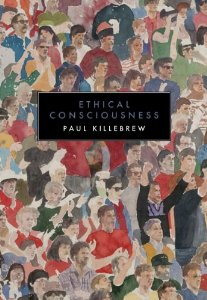
ethicalIn “On a Finger,” which appears near the beginning of Paul Killebrew’s second full-length collection of poems Ethical Consciousness (Canarium Books, 2013), the author writes:
You moved closer
and for the first time
I could see the pattern.
Certainties form,
disband, and
cyclically realign
under different colors,
but each prayer
from the angle of blunt attraction
had a sender,
and every afternoon
its silhouette. (18)
And in the title poem, which immediately follows “On a Finger,” Killebrew writes:
It’s as if the self
were a series of
statements
occasionally arranged
in dizzying
complexity but
mostly repeating
ten or eleven sentences
from the brief oeuvre
of a personality
that grows only
like a balloon—
never more surface,
just more tension
as the surface
spreads. (22)
These two passages provide a fairly accurate account of both the aesthetic tendencies and thematic concerns found within Ethical Consciousness. For starters, Killebrew primarily composes poems that contain lines only a few words in length, thus cutting syntactical (and conceptual) units into discrete elements; yet due to the enjambment that pervades the poems, he maintains a fluid movement and coherent rhetoric.

To this extent, small “Certainties form” within a line, then “disband” as the poem progresses to the next line. But simultaneously with this formation and deformation, an overall rhythm and logic accrue as the poem proceeds, thus “cyclically realign[ing]” the poem with different words and patterns of thought. In other words, one could say that the poet composes the selections within this book as a “series of / statements,” which he “arranges” and re-arranges into a “dizzying / complexity” of “repeating / …sentences” and concepts.

Similarly in “Muted Flags,” the book’s final thirty-three paged poem, the speaker recounts a dream wherein:
I was surrounded
by a choir
of hundreds, all
of them speaking
the question
in unison, with
exactly the same
inflections, inflections
that cycled through
a full range of
emotions—calm
sobriety, anger,
resignation, ecstasy,
and so on—
never hitting
any particular
emotional register
more than once
the entire night. (83)
As the dream progresses, the speaker walks among the choir of voices, listening to each one of them in order to hear how:
his or her voice
was both enmeshed
with and distinct
from the whole,
and then I moved
back to the center
of the ring
they had formed,
their sound intensifying
into a physical
pressure on all
sides of my body (84)
Just as the lines in each of Killebrew’s poems are both distinct units and parts of a whole, so too are the voices of the “choir / of hundreds” both “enmeshed / …and distinct” while cycling through a variety of “emotional registers.”

One could argue, then, that the aesthetic of these poems and the ethical consciousness they promote rely on the interplay between micro-level and macro-level poetics, as well as a negotiation between the individual and community. In other words, Killebrew fosters a type of speech that acts as a “vessel / for transporting thought across dim borders” wherein he addresses “an exact person,” but also the “relationships among” persons as they form in “words / in a conversation” (52): a poetry that, both in content and form, seeks to reconcile the differences between part and whole, the singular and the many.

City Lit by the Light Caught in Photographs

This article first appeared as a post titled "Best Thing I’ve Read This Week: Matt McBride" at Vouched Books on 22 July 2013.

McBride
Matt McBride’s Cities Lit by the Light Caught in Photographs (H_NGM_N BKS, 2012) is a series of portraits composed of urban decay and the castoff detritus of consumer culture that follows, at least thematically, the lineage of Eliot’s apocalyptic vision in The Waste Land. Throughout the chapbook, image after image of a city’s forgotten or damaged remains accrue, building around the reader the architecture of a modern wasteland. Take, for instance, the following excerpts:
an abandoned gas station shuttered with plywood


The phone disconnected
but we got messages anyway:
the kind of things
dentures would say
after their owner died


a thousand set of Russian dolls
haphazard and mismatched
amidst a field of broken televisions.


Each basement was a museum
of progressively rustier stationary bikes.
You’d watch a blank VHS take
‘til it stopped


All the area rugs
are horridly stained


Mannequins, left outside
fuzz with mold
In Cities Lit by the Light Caught in Photographs, these images and others saturate the book’s landscape with a sense of failure, symbolized by the rusted, haphazard, and dilapidated refuse populating the poems.

And just as inanimate objects become discarded remnants, people in these poems have also died or have been forgotten. All that remains of them are ghosts who are “too alone / to be lonely.” Even when they’re encouraged to “feel you are wanted,” the ghost of these poems are readily aware that they’re not “wanted most of the time.” Yes, humans transform into ghosts because even they too are perishable.

Of course, one could argue that the city and those citizens not yet forgotten have disposed of outmoded objects and persons because they’re exchanging them for new and shiny replacements more fit for the future. But in the poem “Cities of the Future,” we learn that this is not the case:
Rusty coats hanger
bang against each other
on tree branches.

The air
smells all hospital.

Our blood feel like soap inside us.

We have people landfills.

We are not uncontent.
It would appear that in the wasteland of McBride’s chapbook, the future is still “Rusty” and the chemical odor of a “hospital” fills the air in order to cover the scent of the “people landfills” were carcasses pile on top of one another. The most frightening aspect of the poem is the collective admission that “We are not uncontent.” No, civilization in this wasteland might not be content, per se, but it’s certainly not discontent. Instead, they look passively at “a scaffolding used to pull stars out by their roots, a kind of urban renewal for the sky,” watching the “urban renewal” of the heavens, but too “not uncontented” to do much about their own plight.

To further compound matters, looking back in reverie to a better time gone by is not an option either. Admonishing those who would look to the past, the speaker of the title poem claims that “Memory is the only pornography”; and later in the collection’s final poem “Cities of Perpetual Distraction,” the speaker declares: “Nostalgia’s a kind of cancer.” Yes, to think of a time passed both fetishizes the past and eats away at our current livelihood. As such, there is no escape in the past or the future; there is only the urban wasteland of the present, which we are complicit in creating.

This, of course, begs the question: does a collection of poetry need to offer its audience an escape, redemption, or a solution to the problems we face in life and literature? Or can a collection of poems simply offer an apocalyptic vision without hope? Cities Lit by the Light Caught in Photographs seems to favor the latter of these two options. While such a stance might not sit well with some, the failing economies and urban decay of cities such as Detroit, Cleveland, and any number of Rust Belt cities argue, sadly, that such a wasteland is already upon us. McBride, who is a native of Dayton, OH and a current Columbus, OH resident, no doubt is quite familiar with these landscapes.

But one could argue, as I did in a review of Russell Atkins' Here In The, that the poetry that derives from these broken cityscapes is itself a redeeming quality. Of Atkins' poetry, I wrote:
in these “hideous” and “abject” images, Atkins creates a singular, Cleveland-based beauty in his language and the sounds it produces. Yes, while his content focuses on the death of a city, he enlivens that very same material through his poetic technique. Through an aestheticized vision of Cleveland, then, perhaps writers and artists living here (and other cities along the Great Lakes) can find an answer to the manner in which we engage our troubled city: acknowledging its decline, but doing so in a way that honors its inherent beauty.
One could say the same thing with regard to McBride's poems. Indeed, the content may be harrowing, but through the act of writing poetry and aestheticizing the decay, we can discover beauty in the destruction.